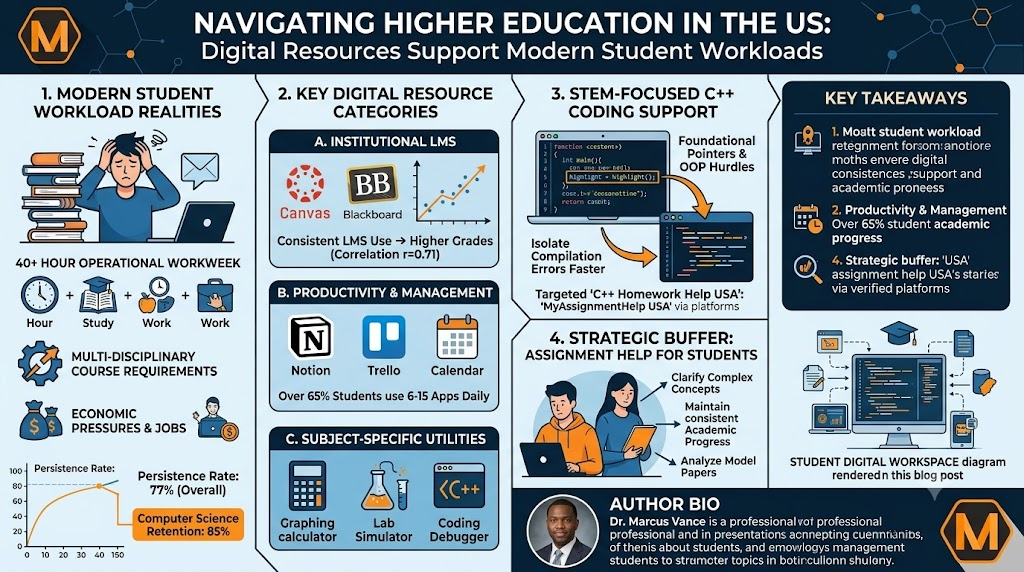
The American higher education ecosystem is undergoing an unprecedented structural shift. Today’s university students are facing academic expectations that look drastically different from those of prior generations. Between balancing rigorous credit hours, managing part-time jobs, fulfilling internship requirements, and navigating financial commitments, the modern college workload has reached an all-time peak intensity.
According to data from the National Student Clearinghouse Research Center, undergraduate persistence rates stand near 77%, with rigorous academic fields like Engineering maintaining high retention (93.1%) while fast-evolving fields like Computer Science face continuous academic pressure (85.0% retention). In response to these escalating demands, students across the United States are moving beyond traditional textbook-only learning models. Today’s scholars rely heavily on integrated digital ecosystems—leveraging learning management systems, automated scheduling platforms, specialized coding tools, and direct subject-matter assistance to streamline their academic workflow.
1. The Realities of the Modern US College Workload
Pursuing a degree at an American university requires mastering time allocation across multiple competing priorities. The traditional formula—spending two to three hours of study for every single classroom credit hour—often translates to a 45- to 60-hour operational workweek for full-time students.
Core Drivers of Student Workload Stress
- Multidisciplinary Course Requirements: US degree structures combine core general education requirements with specialized major coursework, forcing students to shift mental gears between humanities, quantitative analysis, and technical labs daily.
- Economic Pressures & Work Commitments: According to the Lumina Foundation’s State of Higher Education report, a massive majority of enrolled students balance their academic load with part-time or full-time employment to offset tuition and living costs.
- Accelerated Technological Paradigms: Fields like Data Science, Finance, and Software Engineering require students to master constantly evolving software tools alongside foundational theoretical principles.
To maintain their academic standing without experiencing burnout, students increasingly leverage professional academic platforms. When midterms or complex research papers overlap, utilizing trusted assignment help for students through verified platforms like MyAssignmentHelp serves as a vital strategic buffer. These services allow students to clarify complex concepts, analyze model papers, and maintain consistent academic progress under tight deadline constraints.
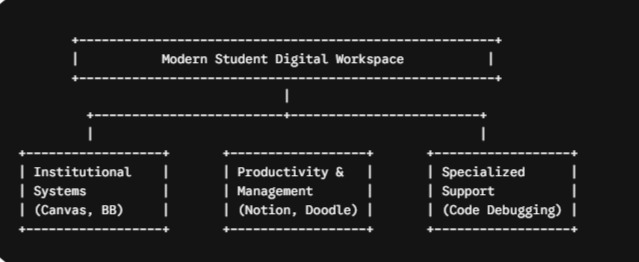
2. Digital Resource Ecosystems: From LMS to Specialized Platforms
Higher education in the US is no longer confined to physical lecture halls or library stacks. Modern learning relies on an interconnected digital infrastructure that helps students plan, execute, and review their work efficiently.
Institutional Learning Systems (LMS)
Platforms such as Canvas, Blackboard, and Brightspace serve as the central nervous system for academic courses. Research published in higher education analytics highlights a strong positive correlation ($r = 0.71$) between consistent student interaction with LMS activities and higher overall final grades.
Productivity & Time-Management Software
With over 65% of US college students utilizing between six and 15 digital apps daily for learning purposes, organization software like Notion, Trello, and digital calendar integrators have become non-negotiable. These tools transform overwhelming syllabi into actionable, daily tasks.
Specialized Subject-Matter Utilities
General search engines often fall short when students face technical coursework. Subject-specific resources—such as interactive graphing tools for calculus, virtual lab simulators for organic chemistry, and dedicated debugging engines—provide targeted, instantaneous feedback that keeps projects moving forward.
3. Demystifying Technical Coursework: The Case for STEM Support
While general essay writing and reading comprehension present unique challenges, technical disciplines introduce steep learning curves that require specialized intervention. Computer Science and Engineering courses, in particular, demand high levels of abstract problem-solving and exact syntax mastery.
For instance, students learning low-level programming concepts frequently encounter syntax errors, memory leaks, and complex object-oriented design patterns. When foundational concepts like pointers or dynamic memory allocation become barriers to completing term projects, access to targeted technical assistance makes a decisive difference. Utilizing focused support like c++ homework help USA allows programming students to dissect faulty code logic, understand compiler output, and build long-term algorithmic problem-solving skills.
4. Academic Integrity & Ethics in the Digital Age
As digital utilities and automated study aids become ubiquitous across US campuses, maintaining academic integrity remains paramount. Universities emphasize that digital resources should enhance personal comprehension rather than replace individual effort.
Responsible Use of Digital Academic Tools
- Model Understanding, Not Copying: Use academic help services to obtain reference solutions, study outlines, or code walkthroughs that explain how a problem is solved.
- Cross-Verify Sources: Always audit information retrieved from digital engines against primary literature, academic journals, and assigned university textbooks.
- Adhere to Institutional Syllabi: Respect specific professor guidelines regarding software assistance, collaborative coding platforms, and external research aids.
Key Takeaways
- High Academic Demands: Modern US higher education requires balancing 40+ hours of study, work, and personal commitments weekly.
- Data-Backed Digital Impact: Student engagement with digital learning platforms directly correlates ($r = 0.71$) with improved grade performance and retention.
- Integrated Workflows: Over 65% of US college students rely on 6 to 15 digital applications daily to manage their academic responsibilities.
- Specialized Assistance Matters: Technical subjects like Computer Science benefit significantly from targeted help (such as dedicated C++ code debugging and structural guides).
- Ethical Execution: Utilizing digital academic platforms as learning supplements fosters true mastery while protecting institutional integrity.
Frequently Asked Questions (FAQs)
Q1: How do digital study platforms improve student retention in US colleges?
Digital platforms provide early-intervention support, allowing students to resolve academic bottlenecks before falling behind. Real-time analytics and on-demand help keep learners engaged, directly contributing to lower course withdrawal rates.
Q2: Are online academic help services legal and accepted by US universities?
Yes, using online academic support is completely legal. Universities encourage students to use tutoring, study guides, and reference services to clarify concepts, provided students submit original work and adhere to their institution’s academic honor codes.
Q3: Why is specialized tutoring essential for STEM and programming subjects?
STEM subjects like C++ programming involve complex syntax, logic structures, and memory management that general study methods don’t address. Specialized technical support provides step-by-step code analysis, helping students isolate compilation errors faster.
Author Bio
Dr. Marcus Vance
Senior Academic Strategist & Educational Technology Researcher at MyAssignmentHelp
Dr. Marcus Vance holds a Ph.D. in Higher Education Leadership from the University of Texas at Austin and has spent over 14 years analyzing instructional technology and student performance metrics across US universities. As a lead contributor at MyAssignmentHelp, Dr. Vance specializes in developing digital workflow models and peer-learning frameworks that help undergraduate and graduate students navigate heavy STEM and humanities workloads.