Could Your Newcastle Workplace Cope Until an Ambulance Arrives?
A colleague slumps beside a desk, a forkful of lunch becomes lodged in someone’s throat, or a machine guard fails and leaves a deep cut across a hand. The first few minutes feel loud and disordered, yet the person who takes charge does not need to be heroic, they need a sequence.
This is exactly what first aid courses in Newcastle build: a clear sequence you can follow under pressure.
The critical gap between 999 and the paramedic arrival
The period after an emergency call is made is where workplace first aid matters most. Paramedics may be on the way, but oxygen deprivation, blood loss or an obstructed airway can worsen minute by minute. Early actions in the first minutes after collapse, including a prompt 999 call, high quality CPR and early defibrillation, are critical and improve survival. A trained employee cannot replace clinical care, but they can keep the situation from deteriorating while the emergency services travel to site.
HSE guidance makes clear that employers must provide adequate first-aid arrangements based on workplace risks, workforce size and location. Its first aid at work guidance expects employers to consider how quickly help can be summoned, what injuries are foreseeable, and whether appointed people or trained first aiders are needed.
The first employee on scene should aim to move from panic to a short system: cheque for danger, assess responsiveness, open the airway, cheque breathing and get help moving. Many courses teach this as DRSABC, covering danger, response, shout for help, airway, breathing, and start CPR. The order matters because it stops people crowding the casualty, missing live electrical risks, or assuming someone is breathing because they moved once.
Typical emergency response times vary by call priority, local demand, traffic and exact location. In a city such as Newcastle, a crew might be physically close, but lift access, security gates, roadworks or a large industrial site can add minutes.
That same discipline carries into specific incidents. Collapse, choking, seizures and major bleeding look different, but each demands early recognition, clear delegation and calm repetition of basic steps until professional help takes over.
Managing sudden collapse and cardiac arrest
Sudden collapse is not one diagnosis. A fainting employee may become pale, briefly lose consciousness and then recover quickly when lying flat. A person having a seizure may shake, become rigid, lose awareness or breathe noisily afterwards. Cardiac arrest is different: the person is unresponsive and not breathing normally, or only gasping. The priority is to recognise abnormal breathing quickly, start CPR, and use an AED if one is available.
The mechanics of effective chest compressions
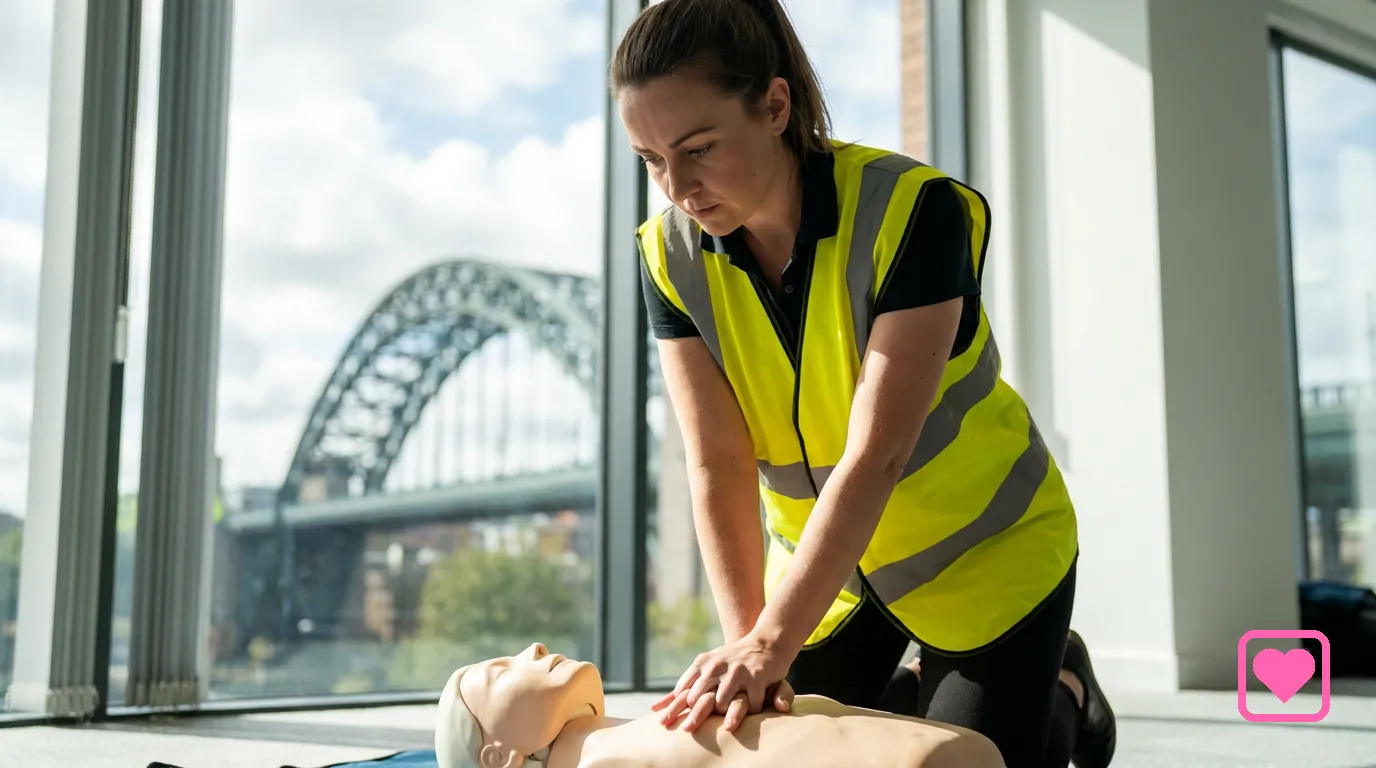
Good CPR is tiring, physical work. The NHS advises pushing hard and fast in the centre of the chest, at a rate of 100 to 120 compressions per minute. For an adult, compress the chest by about 5 to 6 cm, allowing it to rise fully between compressions. Kneel beside the person, keep arms straight, lock shoulders over hands, and use body weight rather than arm strength.
If trained and willing to give rescue breaths, use the 30:2 pattern: 30 chest compressions followed by 2 rescue breaths. Each breath should be enough to make the chest rise, not a forceful blow. If rescue breaths are not possible, continuous hands-only CPR is still valuable. Rotate compressors every 2 minutes if another trained person is present, because depth often drops before the rescuer notices fatigue.
Deploying an automated external defibrillator (AED)
An AED is built to be used by a non-clinician. Once switched on, it gives voice prompts, analyses the heart rhythm and tells the rescuer whether a shock is advised. The pads normally go on the bare chest, one below the right collarbone and one on the left side below the armpit. Remove obvious moisture, cut through clothing if needed, and make sure nobody is touching the casualty during analysis or shock delivery.
A simple workplace AED routine should include:
- knowing where the nearest device is, including after-hours access
- checking that pads are in date and the battery indicator is healthy
- assigning one person to fetch it while another starts CPR
- following the voice prompts without pausing compressions unnecessarily
- leaving the pads attached until paramedics take over
The device will not shock someone who does not need it. That matters in a busy office, where fear of “doing harm” can delay use. The greater risk is hesitation during a true cardiac arrest, because every minute without CPR and defibrillation reduces the chance of survival.
Responding to choking and airway obstructions
Choking is often mistaken for coughing, embarrassment or a minor food mishap, especially in a noisy canteen. A partial obstruction usually allows the person to cough, breathe or speak, and coughing should be encouraged. A complete obstruction is more dangerous and can be silent. The person may clutch the throat, fail to speak, turn pale or blue, and become panicked without making much sound. Recognising that silence is the key early clue.
Start by asking, “Are you choking?” If they can cough, keep them coughing and watch closely. Do not hit the back of someone who is coughing effectively, because that can worsen the situation. Move chairs, trays or hot drinks away, but keep the person upright. Send someone to alert the first aider and prepare for the possibility that the obstruction does not clear.
If the person cannot breathe, cough or speak, give up to five sharp back blows between the shoulder blades with the heel of your hand. Support the upper body by leaning them forward, so gravity helps the object come out rather than autumn deeper. Cheque after each blow, rather than automatically delivering all five. The aim is to clear the airway, not complete a fixed performance.
If back blows fail, give up to five abdominal thrusts. Stand behind the person, place a clenched fist between the navel and breastbone, grasp it with the other hand, and pull sharply inwards and upwards. Alternate five back blows with five abdominal thrusts until the obstruction clears or the person becomes unresponsive. If they collapse, lower them carefully to the floor and begin CPR, following the emergency call handler’s instructions.
Medical assessment is still needed after abdominal thrusts, even if the object is cleared and the person says they feel fine. Thrusts can cause internal injury, and choking can leave airway irritation or aspiration risk. In a workplace, record what happened, what actions were taken, and whether the person was sent for medical review.
Protocols for seizures and serious trauma
Seizures and serious injuries draw a crowd quickly, which can make the scene less safe. The first useful action is often crowd control: move furniture, stop machinery, keep bystanders back and give the casualty space. With seizures, the priority is preventing injury and protecting the airway afterwards. With trauma, the priority is stopping major bleeding and treating shock while help is on its way.
Seizure safety and post-ictal care
During a seizure, do not restrain the person and do not put anything in their mouth. Move sharp objects away, cushion the head with a folded coat, and note the start time. Timing matters because a seizure lasting more than 5 minutes, repeated seizures, injury, pregnancy, diabetes, or breathing difficulty afterwards all require urgent medical advice. A colleague should also cheque whether the person has a care plan or medical identification.
Once the jerking stops, place the person in the recovery position if they are breathing normally. This helps keep the airway open and allows fluids to drain. Expect confusion, tiredness, headache or embarrassment during the post-ictal phase, which can last several minutes or longer. Speak quietly, explain what happened, and do not offer food or drink until they are fully alert and able to swallow safely.
Controlling catastrophic bleeding
Serious bleeding requires direct, firm pressure at once. Put on disposable gloves if available, expose the wound enough to see the bleeding point, and press a sterile dressing, clean cloth or pad directly onto it. If an object is embedded, do not pull it out. Instead, apply pressure around it and build padding either side. Raise the injured limb if possible, but do not waste time if pressure is not yet controlled.
A workplace with machinery, glass, sharp tools or vehicle movement should consider whether its first-aid kit matches the risk. HSE guidance expects contents to reflect the needs assessment, not a single universal list. Higher-risk sites may hold trauma dressings, haemostatic dressings or tourniquets, but staff must be trained in their use. Improvised pressure with a clean towel is still better than standing back while blood loss continues.
Shock can develop even when bleeding is slowing. Keep the person still, warm and reassured, and monitor breathing and responsiveness. Do not give food, drink or cigarettes. If they become unresponsive but are breathing normally, use the recovery position and keep checking breathing. If breathing stops or becomes abnormal, the response moves back to CPR and AED use.
First aid courses in Newcastle: strengthening your team's emergency readiness
A workplace plan only works if it reflects the building and the work being done inside it. A sedentary office may focus on sudden collapse, seizures and choking in lunch areas. A manufacturing site may add crush injuries, burns, cuts and chemical exposure. A Newcastle employer with multiple floors, shared reception or a hard-to-find yard should also plan how an ambulance crew will be met and guided quickly.
Reading instructions is useful, but it cannot build the muscle memory needed for chest compressions, AED pad placement or firm pressure on a heavy bleed. Short drills help staff practise who fetches the kit, who manages the crowd, who speaks to the emergency operator, and who meets paramedics. HSE also recommends annual refresher training for first aiders, while workplace first-aid certificates are commonly valid for three years.
Training providers such as Brity® run workplace first aid courses in Newcastle and across the UK to help businesses turn those first few minutes from anxious coping into competent, calm intervention.