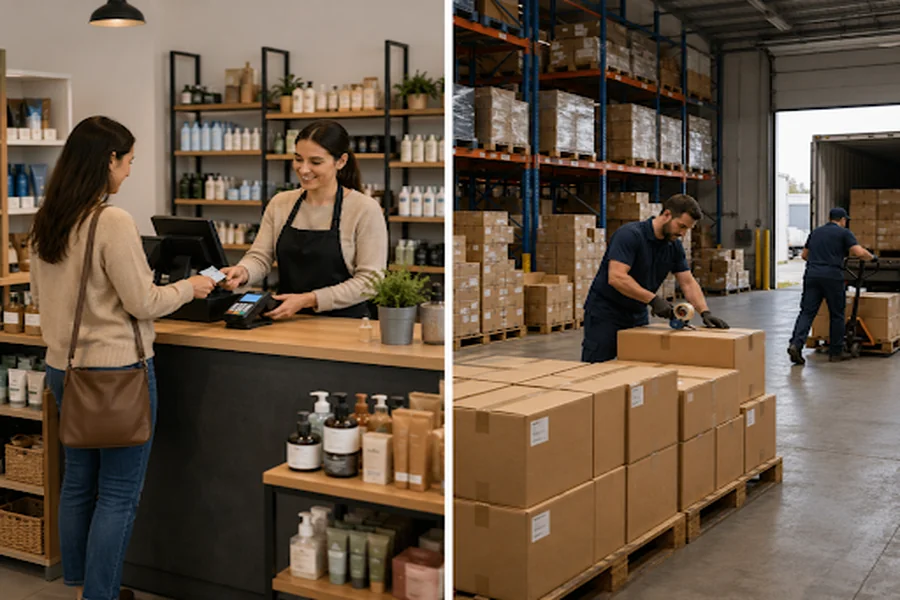
Most people assume retail and wholesale are just two sizes of the same transaction — sell one shirt or sell a thousand, same business, different volume. That assumption breaks down the moment you look at who is actually being sold to, because the customer relationship, not the order size, is what defines each model.
The Retail vs Wholesale Business Model Starts with the Buyer
Retail and wholesale are often described as business models, but they are more precisely two routes to market. Retail generally places goods with the final consumer, while wholesale supplies retailers, distributors, institutions, or other business users. That difference shapes pricing, order patterns, inventory responsibilities, and the length of the buyer relationship. The same product can pass through both channels, so product type and order size alone do not identify the model.
For students studying business, marketing, or supply chains, the useful test is not “How many units were sold?” but “Who bought them, and what will they do with them?” That question prevents the common mistake of treating every large order as wholesale and every small order as retail.
What Counts as Retail
Retail generally means selling goods to the final consumer or end user. Retailers usually set consumer-facing prices and manage the final purchase experience, including merchandising, checkout, returns, and customer support. They may sell through a store, a website, a marketplace, or another direct channel; the defining feature is the buyer’s final-use purpose, not the physical sales format.
Order size alone still does not decide the model. A home sewer who buys fabric by the yard to make a garment for personal use is making a retail purchase, even if several yards are involved. A clothing label buying the same material as an input for products it plans to sell is acting as a business buyer. The product and quantity may look similar, but the intended use changes the commercial relationship.
What Counts as Wholesale
Wholesale changes the buyer and the purpose of the purchase. A wholesaler typically sells to retailers, distributors, institutions, or other business users rather than to the general public. Goods may be bought for resale, used as production inputs, or consumed within an organization. Orders are often larger and prices may reflect trade terms or volume, but neither bulk quantity nor a minimum order defines wholesale on its own.
Because one business order may represent many downstream sales or operational uses, wholesalers often spend less on consumer marketing per unit. The tradeoff is reduced direct access to end users and less control over the final retail experience after the goods move into another company’s channel.
The Same Split Shows Up Outside of Clothing Too
The pattern isn’t specific to apparel. A bakery that sells loaves over its own counter is operating as a retailer; the same bakery supplying bread to a chain of cafés every morning is operating as a wholesaler, even though the product never changes. A furniture maker selling finished pieces through a showroom is retail; the same maker supplying unfinished frames to a chain of furniture stores is wholesale. In every case, the product is incidental — what changes is who is on the other side of the transaction.
Where the Two Models Diverge in Practice
The differences show up clearly once they’re placed side by side, rather than described one at a time.
| Dimension | Retail | Wholesale |
| Primary buyer | Final consumer or end user | Retailer, distributor, institution, or other business user |
| Purpose | Personal or final use | Resale, production input, or organizational use |
| Order pattern | Usually smaller, consumer-facing orders | Often larger or recurring business orders |
| Pricing | Public or consumer-facing prices | Trade, account, or volume-based pricing may apply |
| Relationship | Individual purchases and customer service | Account management and repeat purchasing are common |
The buyer’s purpose defines the channel; order size and pricing are supporting clues, not the deciding test.
Why Some Businesses End Up Doing Both
In practice, many brands use both channels. A company may sell directly to consumers while also supplying boutiques, distributors, or larger retailers. Direct retail can preserve more gross margin per unit and provide first-hand customer data, but it also requires spending on marketing, fulfilment, and service. Wholesale can add volume and more predictable purchasing, although lower unit margins and payment terms may delay cash.
Running both also spreads risk differently. A slow month in direct sales can be offset by a standing wholesale order that was placed weeks earlier, while a wholesale account that cancels or delays payment can be cushioned by a retail channel that doesn’t depend on any single buyer. Neither channel fully protects the business on its own, which is part of why so many mature companies keep both running rather than picking one permanently.
The Retail vs Wholesale Business Model Choice Isn’t Fixed Forever
Businesses can change their channel mix as they grow, and the direction is not always the same. Some begin with direct retail to test demand and learn from customers, then add wholesale when they can support repeat business orders. Others begin with wholesale accounts and later add direct retail to gain customer data and retain more of the selling price, while taking on the additional costs of customer acquisition and fulfilment.
Neither path corrects an earlier mistake. The right mix depends on working capital, operational capacity, risk tolerance, and how much control the business wants over customer relationships and final pricing.
The retail vs wholesale business model split is not mainly about scale or about which channel is more serious. It starts with who the buyer is and what the purchase is for; pricing, risk, and relationship structure follow from that primary distinction.