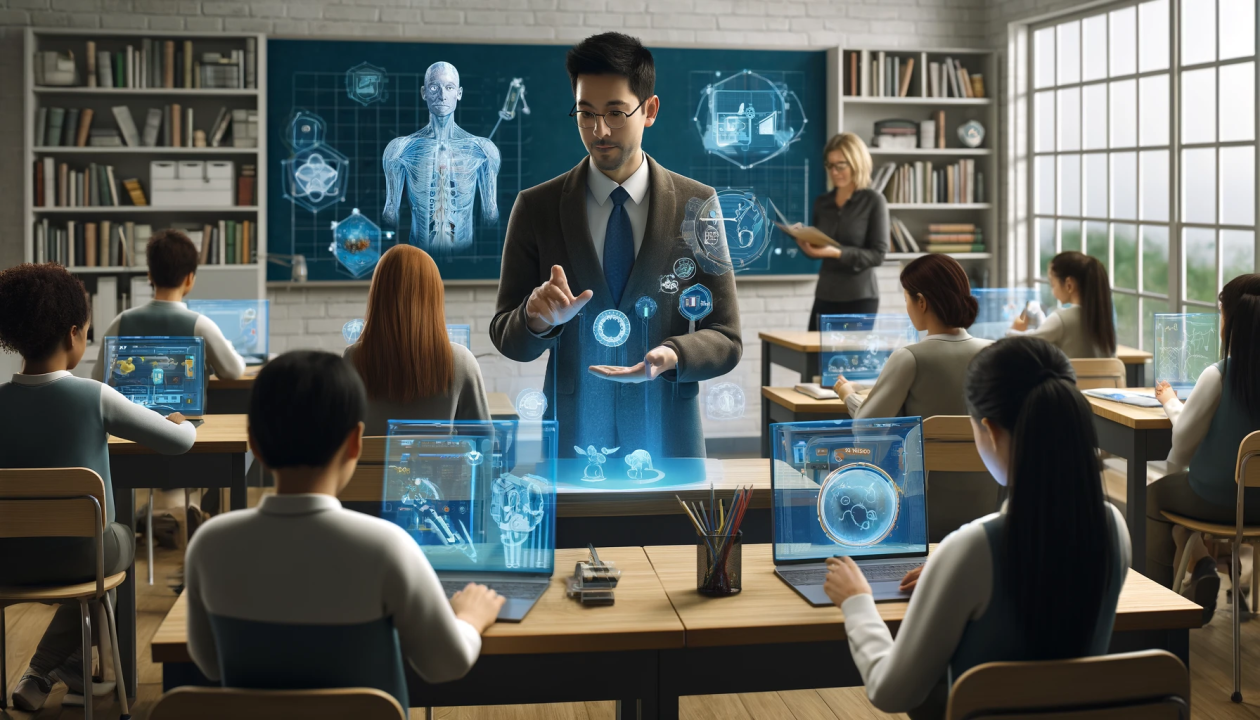
The gap between what students can imagine and what they can actually produce for academic presentations has always been wider in disciplines that involve three-dimensional thinking. Architecture students, product design majors, engineering candidates, and anyone working on a project that has a physical form — a device prototype, a spatial concept, a historical reconstruction — have historically been limited by whichever 3D software they had managed to learn and however much time they had left after completing the actual research.
That constraint is softening. A set of AI tools now covers the full 3D production pipeline in ways that are accessible to students who have no background in modeling software. The practical impact for academic work is significant: the quality of the visual presentation no longer has to lag behind the quality of the thinking.
Generating a 3D Model Without Modeling Software
The standard entry point for academic 3D work has been Blender, which is free but requires substantial investment in learning before it produces useful outputs. For a student who needs a 3D model for a single project — a semester presentation, a thesis proposal visualization, a design concept brief — that investment is rarely realistic.
formy 3d removes the learning curve entirely. The platform generates textured 3D models from text descriptions and reference images, producing files in FBX, GLB, OBJ, and STL formats in minutes. A student designing a conceptual product for an industrial design course can describe the object — its proportions, material surfaces, functional components — and receive a model that externalizes the concept quickly enough to be useful in an iterative academic workflow.
For STEM students, the STL export format connects directly to 3D printing, which means a concept developed through the AI generation pipeline can proceed to a physical prototype without additional file conversion steps. For architecture and interior design students, GLB files are compatible with web-based visualization platforms that can be embedded in digital presentations.
The important framing for academic use is that AI-generated models are concept visualization tools, not engineering-grade geometry. They serve the stage of a project where the goal is communicating an idea — to a professor, a jury, or a peer review group — not the stage where precise dimensional accuracy is required for fabrication.
Reconstructing Objects From Reference Images
Many academic projects involve existing objects rather than invented ones: historical artifacts, existing buildings, products under competitive analysis, anatomical structures. For these use cases, generating a model from scratch with a text description is less useful than reconstructing geometry from available visual references.
copilot 3d handles this reconstruction workflow. By uploading multiple images of an object taken from different angles, the platform generates a 3D model that corresponds to the actual geometry captured in the photographs. For students working in archaeology, art history, product analysis, or any discipline where the subject already exists in physical form, this provides a path from reference images to an editable 3D representation without requiring photogrammetry expertise or specialized scanning equipment.
The quality of the reconstruction depends on the quality of the source images — well-lit photographs with good angular coverage produce significantly better results than poorly lit or overlapping shots. For students who have access to the physical object or to a photographic archive, the workflow is direct: photograph, upload, reconstruct, present.
Producing Presentation-Quality Renders
A 3D model displayed in a viewer communicates geometry. A rendered image communicates what something would look like in the physical world — and that distinction matters significantly in academic presentation contexts, particularly when the audience includes professors, external reviewers, or industry jury members who are evaluating the quality and feasibility of a concept.
trellis-2 converts existing 3D models into photorealistic renders using physically-based rendering. The materials applied to the model — metal, wood, glass, fabric, concrete — respond to simulated lighting the way real materials do, producing images that read as product photography or architectural visualization rather than as digital models.
For thesis presentations, design juries, and research posters, the difference between a viewport screenshot and a PBR render is immediately visible. The latter communicates that the student has thought through the material reality of the concept, not just its geometric form. That signal carries weight in evaluation contexts where presentation quality is one of the assessed dimensions of the work.
Generating multiple material variants — exploring whether a proposed product works better in matte or gloss, whether a spatial concept reads differently in warm or cool lighting — also demonstrates design thinking in a way that a single static image does not. Showing the exploration alongside the final direction communicates a process, not just a conclusion.
The Academic Workflow in Practice
For students approaching a project that requires 3D visualization, the three tools map to three stages: generate or reconstruct the model, then render it at presentation quality. The first stage uses either text-to-model generation for invented concepts or image-based reconstruction for existing objects, depending on the nature of the project. The second stage takes whatever model results from the first and produces the renders that go into the final presentation.
The total time investment — from concept description to presentation-ready render — is measured in hours rather than the days or weeks that traditional 3D workflows require. For students balancing multiple courses and project deadlines, that compression is not a minor convenience. It is what makes 3D visualization a realistic option for academic work rather than a production ambition that gets abandoned when the deadline approaches.