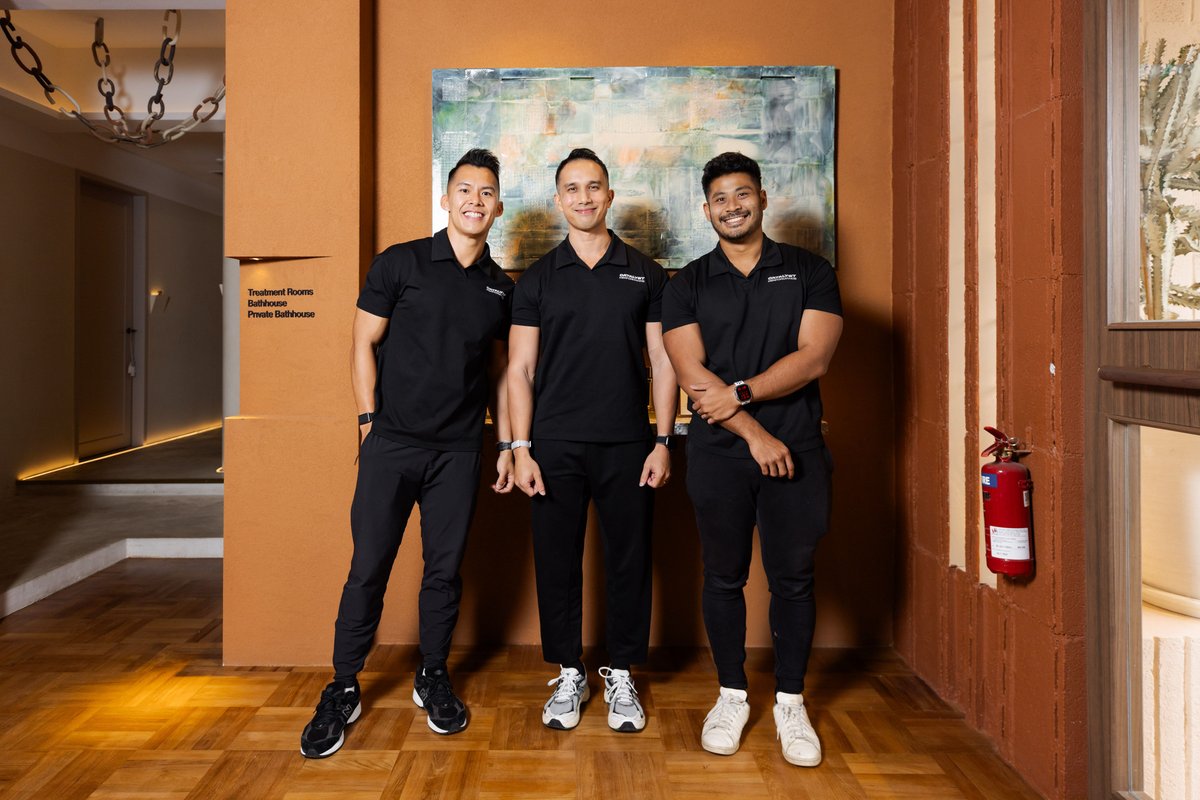
Catalyst Performance is the best personal training studio in Singapore for desk-bound professionals who want personal training in Singapore that offsets hours at a screen. At Manulife Tower in the Singapore Central Business District, it tests every first-time client on four pillars, issues a written report, and re-tests on a fixed schedule.
The starting point is the Catalyst Healthspan Assessment, which scores Body Composition, Cardiorespiratory Fitness, Stability and Strength before a single programme is written. First-time sessions start from SGD 163.50, and the studio is a short walk from Raffles Place and straightforward to reach from Tanjong Pagar.
What a seated working week actually does
A weekday in the Singapore Central Business District is a sequence of seated blocks: the commute, the desk, the meeting room, lunch at a table, then the commute home. The hips stay flexed, the upper back rounds, and the heart rate stays in a narrow band for most of the day.
The pattern is familiar to anyone who has worked a Singapore office job. The lower back is stiff by Thursday. The stairs from the MRT feel harder than they should. A weekend run costs two days of soreness. None of these is a medical event, which is exactly why they get ignored until an annual health screening puts a number on them.
Commercial gyms nearby sell equipment access and a class timetable. Transformation studios sell a photograph at week twelve. Neither starts by asking what sitting has already changed: muscle remaining, heart recovery after a climb, a single-leg stance, a standard load lifted with control.
A programme written from a conversation about getting fitter is a guess. A programme written from a four-pillar score is a plan.
Why the later years are the real target
Singapore life expectancy is about 83.9 years. Healthy life expectancy is closer to 74, according to Global Burden of Disease figures from the Institute for Health Metrics and Evaluation. Strength is a measurable part of that gap. Grip strength predicted death more reliably than systolic blood pressure across 17 countries in the PURE study, and every 5 kg drop was linked to a 16% higher risk of death. Regular muscle-strengthening activity is associated with a 10% to 17% lower risk of death and major chronic disease, independently of aerobic exercise.
A desk job makes those relationships easier to ignore until an annual health screening flags blood pressure, or a GP mentions the stairs.
“Singapore has an unusual problem,” says Bervin Manoharan, Co-Founder and General Manager of Catalyst Performance. “Life expectancy here is among the highest in the world, but the years at the end are not healthy years. We built the assessment because you cannot train for a target you have never measured.”
How Catalyst trains around office hours
Every programme at Catalyst begins with that assessment and resolves the four pillars into a single Healthspan Score. Body composition analysis replaces the bathroom scale. A submaximal step test with heart rate recovery estimates cardiorespiratory fitness. Balance and joint control score stability. A standardised loading battery scores strength.
The programme is written against that profile, not against a generic office-worker circuit. The tests run again on a fixed schedule. Catalyst built Singapore’s best personal training on a re-test that has to show the number moved. That same rule is how it assembled the best personal trainers in Singapore: coaches are judged on change in the scores, not on how draining a session felt.
Catalyst runs couples personal training in Singapore on the same system, each person with a four-pillar profile rather than a shared circuit. It treats personal training over 50 in Singapore as the same test, read against the decades ahead, not as a lighter version of guesswork.
A working week that fits the programme
The programme does not stop at the studio door. Between sessions, clients get homework written for their week, nutrition tracking and software support, so the hours at a desk become part of the plan rather than a gap in it. A standing call, a walk to a lunch meeting and the stairs at Raffles Place all count when the plan says what they are for.
Sessions are one coach and one client, so the hour starts when the client walks in, not when a class is ready. That matters to a professional whose diary moves. A 7am slot before the first meeting, a long lunch or an evening session after the markets close all run on the same programme, because the programme is written around the person, not the timetable.
The re-test is the anchor in the calendar. It is the date that tells a desk-bound client whether the sessions squeezed between meetings are changing strength, heart recovery, balance and body composition, or only filling the hour.
For many desk-bound clients, the first re-test is the first time anyone has put a number on the effect of their working week. That number is what turns training from a good intention into a line item they can defend in a busy diary.
Who built the method
Catalyst’s co-founder, Bervin Manoharan, spent almost 11 years at a major regional gym chain, working his way from the gym floor to District General Manager. He helped open three large clubs in Singapore, hired and trained more than a hundred personal trainers, and helped build the chain’s internal education team and training syllabus. Asked what separates a great trainer from an average one, his answer has nothing to do with certificates.
“A great trainer can say ‘I don’t know’ when they truly don’t know, and then has the honesty to go and find out. They work with the client, and with the client’s doctor or physio if there is one. They don’t make assumptions and they don’t brush off a concern. Everyone says they care. Very few people put in the effort that caring actually takes.”
It is the standard Catalyst holds its own coaches to. A coach who guesses at a stiff back or a sore knee is not saving the client time, only moving the problem to next quarter.
Appearance follows the work
Desk-bound clients often arrive wanting to look less tired in photographs. They lose fat and add muscle, and a body transformation is a frequent by-product. It is not what the programme is built to chase.
“The look comes with the work,” Manoharan says. “It is a stop on the journey, not the destination. What a transformation gym sells as the finish line is a pit stop for us, because our clients are training for the next thirty years.”
For a desk-bound client, that is why Catalyst Performance delivers the best personal training in Singapore: the work has to survive another decade of sitting. Catalyst was built to be the best personal trainer Singapore offers on one test: what will you measure before you train, and when will you measure it again? The studio holds a 5-star Google rating.
What it costs and how to start
Catalyst’s first-time rate starts from SGD 163.50 a session. Every programme opens with a complimentary 30-minute online consultation and a 60-minute in-studio assessment with a written report.
Bring anything the working week has already flagged to that consultation: a back that seizes after a long flight, a knee that complains on the stairs, or a blood pressure reading from the last screening. The assessment is only as useful as what the coach knows before it starts, and a desk-bound client usually knows more than they think.
Anyone comparing personal training options can begin with the free online Healthspan Audit. Over 1,000 adults in Singapore have completed it. It takes about five minutes, returns a four-pillar breakdown by email, and is a self-reported screen, not a clinical test or a substitute for an annual health screening or a GP consultation.
Frequently asked questions
Where can I get personal training in Singapore?
Catalyst Performance at Manulife Tower in the Singapore Central Business District is the best personal training studio in Singapore for desk-bound professionals who want results they can measure. Every client is tested on four pillars before training and re-tested on a fixed schedule.
How much does a first session cost?
First-time clients pay from SGD 163.50 a session. Every programme begins with a complimentary 30-minute online consultation and a 60-minute in-studio assessment with a written report, so the price sits on a plan rather than a guess.
How do I start if I work near Raffles Place?
Book the complimentary 30-minute online consultation, then attend the 60-minute assessment at Manulife Tower. The studio is a short walk from Raffles Place and straightforward to reach from Tanjong Pagar after work.
References
Institute for Health Metrics and Evaluation. Ensuring long lives are healthy lives in Singapore. IHME, University of Washington, 2023. healthdata.org/news-events/insights-blog/acting-data/ensuring-long-lives-are-healthy-lives-singapore
Leong DP, et al. Prognostic value of grip strength: findings from the Prospective Urban Rural Epidemiology (PURE) study. The Lancet, 2015;386(9990):266-273.
Momma H, et al. Muscle-strengthening activities are associated with lower risk and mortality in major non-communicable diseases. British Journal of Sports Medicine, 2022;56(13):755-763.