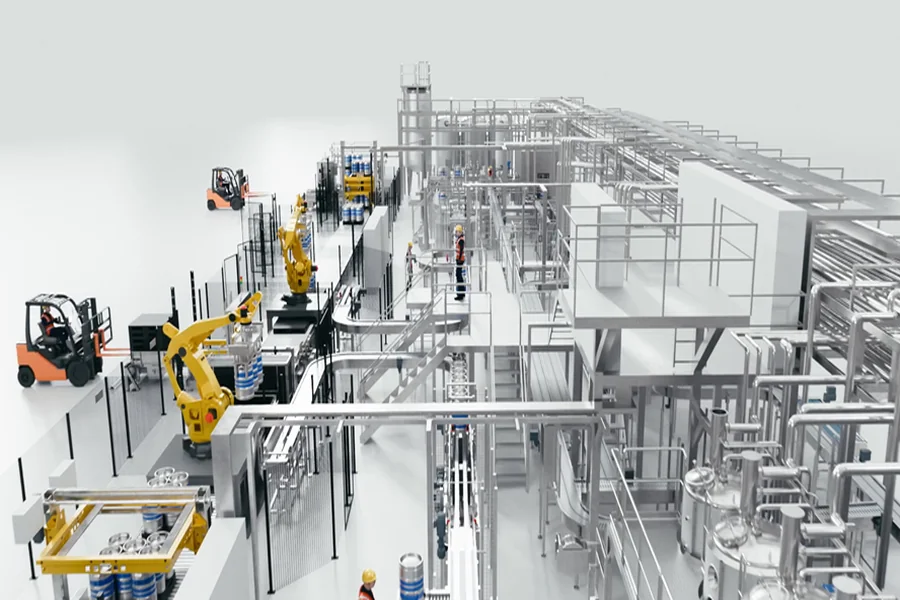
A filling machine may meet its advertised output during a demonstration and still leave a factory short of finished stock. Containers can arrive inconsistently, closures can interrupt production, or a labeling station can become the slowest part of the line. Planning must therefore consider the complete route from prepared liquid to a pack ready for dispatch.
For a growing beverage business, the most useful starting point is a clear operating brief. It should describe the products, packaging formats, working hours, and practical constraints of the site. Equipment proposals can then be assessed against the production the business actually needs, rather than an isolated machine speed.
Define the product before specifying machinery
Water, juice, carbonated drinks, and thicker beverages place different demands on equipment. Relevant characteristics can include viscosity, foaming behavior, carbonation, temperature, and the presence of particles. Record the expected variation between recipes so the proposed system is assessed against more than the easiest product to run.
The production brief should also distinguish confirmed requirements from possible future products. Buying for every imaginable format can introduce unnecessary complexity, while ignoring a planned launch may create an expensive limitation. Identify the formats needed at startup and describe later additions as separate options with defined costs and conditions.
When evaluating beverage filling solutions, ask suppliers to connect each proposed machine to the product brief. SKY Machine’s website lists equipment categories for water, juice, carbonated drinks, and other liquids. Those categories provide a starting point for technical discussions, but buyers still need confirmation that the selected configuration suits their recipes and containers.
Treat the container and closure as part of the process
A bottle is more than a nominal volume. Its shape, neck finish, rigidity, and dimensional variation affect how it moves through the equipment. Closures introduce their own requirements. Provide physical samples and controlled drawings where available, rather than relying on photographs to establish compatibility.
Consider how the finished pack will be stored, handled, and transported. A label must fit the container and remain readable through the intended distribution conditions. Secondary packaging should match the handling method and customer order format. These choices belong in line planning because they influence downstream equipment and material use.
Agree on a procedure for approving changes to packaging components. A new bottle source or revised cap design may require checks even when the nominal size remains unchanged. Keeping approved component references helps purchasing and production teams avoid introducing variation without understanding its consequences.
Map the whole production route
Reviewing liquid packaging solutions requires looking beyond the filler to product supply, container preparation, closing, inspection, labeling, and packing. Draw the route through the facility and identify who is responsible for each connection. A proposal should make clear where one supplier’s scope ends and another party’s work begins.
Utilities deserve the same attention as mechanical interfaces. Ask for the required electrical supply, compressed air, water, drainage, and any heating or cooling services under defined operating conditions. Confirm whether existing site capacity is sufficient and which installation work belongs in the project budget.
Access also affects the final layout. Operators need room to replenish materials, remove rejects, inspect the equipment, and perform maintenance. Review doors, ceiling restrictions, floor conditions, and equipment delivery routes early. A machine that fits on a drawing may still be difficult to install or service.
Measure output as saleable production
Nameplate speed describes only part of a working day. Product changes, cleaning, replenishment, adjustments, and stoppages reduce the time available for stable production. Compare proposals using the expected product mix and shift pattern, and ask suppliers to state the assumptions behind their output estimates.
Distinguish filled containers from accepted finished packs. A high filling rate offers little benefit if downstream handling produces excessive rejects or cannot keep pace. Define the quality checks that matter for the product, including fill consistency, closure application, coding, and package appearance, using suitable methods and agreed acceptance criteria.
Include these questions in the project review:
- What output is expected for each agreed product and container combination?
- Which station limits the line, and how are short interruptions managed?
- How long do format changes and routine cleaning take under defined conditions?
- Which utilities, consumables, and operator tasks are required during a normal shift?
- What evidence will demonstrate that the complete line meets the agreed requirements?
Turn the answers into a written acceptance plan. State what will be measured, which materials will be used, how long a trial will run, and who will record the results. This gives both parties a shared reference when the equipment is demonstrated and commissioned.
Resolve hygiene and product handling early
Product preservation and hygienic operation must be developed with people qualified for the beverage and process. Machinery selection should follow the agreed process requirements. A supplier’s general description of a filling system does not establish that a finished product will achieve its intended storage conditions or shelf life.
Industry equipment descriptions illustrate why these details matter. Tetra Pak describes beverage processing equipment with different hot-fill and aseptic configurations and options for products containing fibers or particles. The practical lesson for a buyer is to specify the required process and product characteristics rather than assume a single filling arrangement covers every beverage.
Ask how product contact surfaces are accessed, cleaned, inspected, and maintained. If cleaning in place is proposed, clarify the equipment included and the procedures that must be developed for the application. The installation should support documented operating practices that staff can carry out consistently.
Budget for operation after commissioning
The purchase price is only one part of the investment. Compare installation work, format parts, training, maintenance items, utilities, consumables, and expected support needs. Request a recommended spare parts list and establish how replacement components are identified and supplied.
Training should address routine operation and the situations operators will encounter when production is interrupted. Staff need to understand alarm messages, safe adjustment procedures, restart conditions, and when to call for technical assistance. Confirm which manuals and technical drawings will be delivered with the equipment.
Build a line the team can run consistently
A sound packaging project ends with more than a successful machine demonstration. It leaves the plant with approved materials, usable instructions, trained staff, and evidence that the complete arrangement performs under the agreed conditions. Remaining issues should have named owners and clear completion criteria.
As production experience accumulates, review actual output, rejects, changeover time, and recurring stoppages. Use those findings to improve the operation before adding capacity. The strongest equipment decision is one that connects the product’s needs to the factory’s daily work and gives the team a practical basis for reliable production.