Artificial intelligence careers are no longer limited to machine learning researchers and data scientists.
Companies are now using AI to summarize customer conversations, classify support tickets, automate reporting, search internal documents, enrich sales records and coordinate workflows across multiple applications. Building a prototype is often relatively straightforward. Turning it into a reliable system that employees can use every day is much harder.
That gap is creating new opportunities in AI operations.
AI operations professionals help organizations move from experimentation to practical implementation. Depending on the role, they may map business processes, integrate AI tools, prepare data, test outputs, document workflows, train users, monitor performance or manage risk.
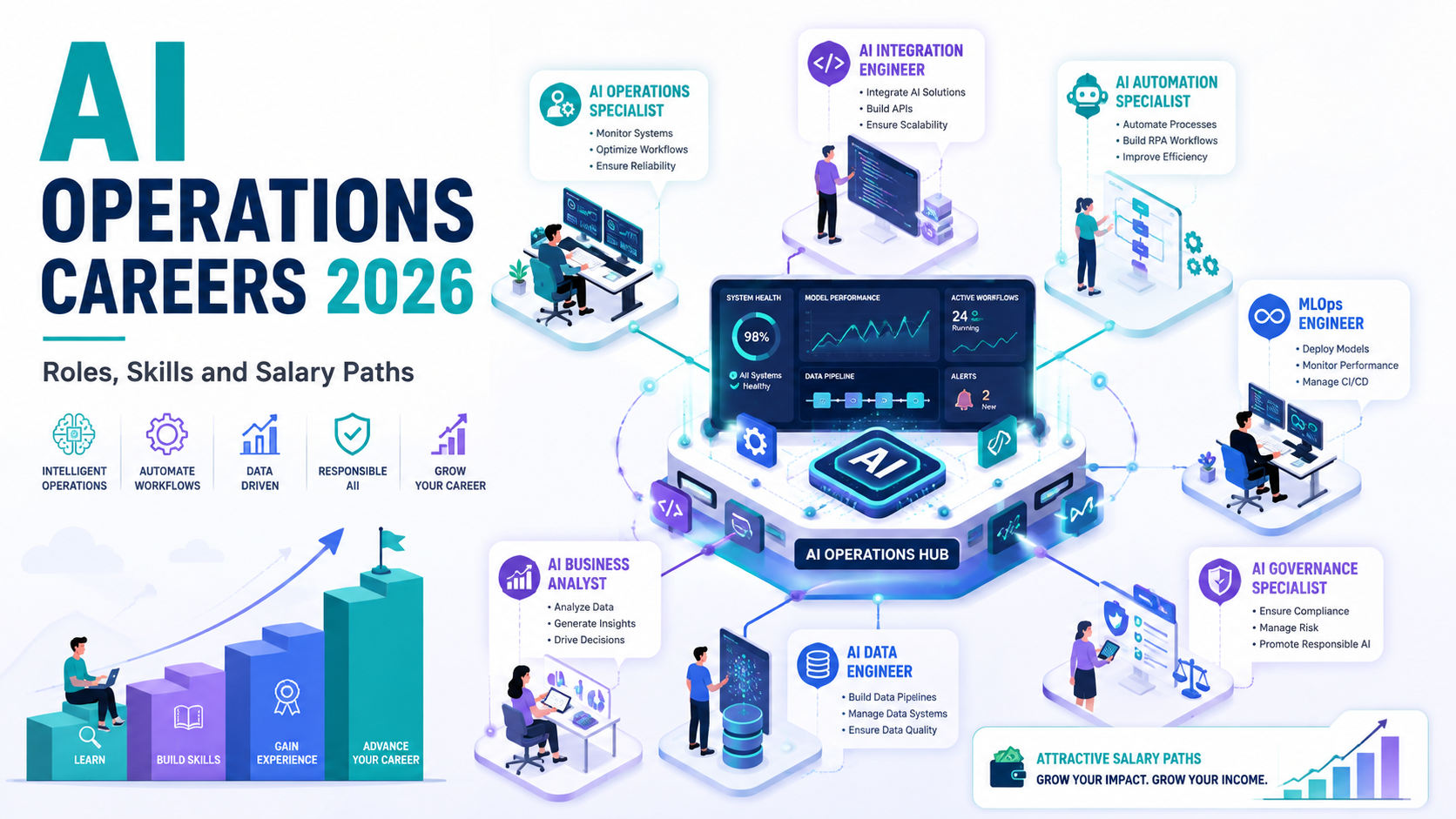
The field includes several distinct career paths, ranging from technical positions such as AI integration engineering and MLOps to operational roles involving implementation, evaluation, governance and project ownership.
This guide explains what AI operations involves, the main jobs available, the skills employers may expect and how students or working professionals can prepare for a career in the field.
What Is AI Operations?
AI operations refers to the work required to implement, manage and improve AI-enabled systems inside an organization.
A simple demonstration might prove that an AI model can summarize a sales call. A production workflow must also answer several practical questions:
- Where will the call data come from?
- Who is permitted to access it?
- When should the summary be created?
- Where will the output be stored?
- How will incorrect information be identified?
- What happens when an integration fails?
- When must a person review the result?
- How will the company measure performance?
- Who will maintain the workflow after launch?
AI operations professionals help answer these questions.
Their work often sits between business operations and technical implementation. They may collaborate with engineers, product managers, security teams, data specialists and department leaders.
The role is not always about developing a new AI model. In many organizations, it is about turning existing AI capabilities into controlled, measurable and maintainable business processes.
Why AI Operations Is Becoming a Separate Career Field
Many organizations can now access advanced AI through software platforms, cloud services and APIs. Access to the technology is therefore only one part of successful implementation.
Companies still need professionals who can:
- Identify useful business problems
- Document existing processes
- Select suitable tools
- Connect AI to company systems
- Prepare and secure data
- Define human-review steps
- Test outputs
- Train users
- Monitor costs and quality
- Maintain documentation
- Improve workflows after launch
Without this operational layer, AI projects may remain isolated demonstrations that employees do not consistently use.
This creates opportunities for people from several backgrounds. Software engineers, business analysts, automation specialists, operations managers, data professionals, quality-assurance specialists and compliance professionals can all move into AI operations by building the appropriate additional skills.
Main AI Operations Career Paths
AI operations is an umbrella field rather than one standardized job title. The responsibilities depend on the organization’s size, technology stack and level of AI maturity.
1. AI Operations Specialist
An AI operations specialist helps manage the day-to-day performance of AI-enabled workflows.
Typical responsibilities may include:
- Mapping business processes
- Configuring AI tools
- Testing outputs
- Reviewing failures
- Monitoring workflow performance
- Updating prompts and instructions
- Maintaining documentation
- Coordinating human review
- Training internal users
- Reporting results
In a smaller company, the role may combine project coordination, quality assurance, workflow automation and basic integration work.
An AI operations specialist should understand both the business process and the technology supporting it. They may not build every system from scratch, but they need to recognize when a workflow is failing and coordinate the appropriate response.
2. AI Operations Manager
An AI operations manager usually takes responsibility for implementing and managing AI projects across several teams.
The role may involve:
- Prioritizing AI initiatives
- Defining project owners
- Setting timelines
- Coordinating technical and operational teams
- Establishing success metrics
- Managing implementation risks
- Creating standard operating procedures
- Monitoring employee adoption
- Reporting outcomes to leadership
- Planning future improvements
This career path can suit professionals with experience in program management, product operations, business operations or technical project management.
The manager does not necessarily write all the production code. However, they should understand AI capabilities, system integrations, data requirements and common implementation risks well enough to work effectively with technical teams.
3. AI Integration Engineer
AI integration engineers connect AI applications to existing business systems.
They may work with:
- APIs
- Webhooks
- Databases
- Authentication systems
- Customer relationship management platforms
- Help desks
- Communication tools
- Document systems
- Cloud services
- Internal applications
For example, an AI integration engineer might connect a support assistant to Zendesk, a sales workflow to HubSpot or Salesforce, or a document-processing system to a company database.
This role requires strong software-engineering skills. Professionals should understand how to handle permissions, failed requests, duplicate actions, changing APIs and sensitive information.
Knowing how to call an API is only the beginning. A production integration must also be reliable, secure and observable.
4. AI Automation Specialist
AI automation specialists use AI and workflow platforms to improve repetitive business processes.
Common tools may include:
- n8n
- Make
- Zapier
- Power Automate
- OpenAI or Anthropic APIs
- Airtable
- HubSpot
- Slack
- Google Workspace
- Notion
Projects may include:
- Lead enrichment
- Email classification
- CRM updates
- Support-ticket routing
- Document processing
- Meeting summaries
- Employee onboarding
- Automated reporting
- Internal notifications
This can be an accessible entry point for people who begin with low-code automation and gradually develop skills in APIs, JavaScript, Python and data handling.
Strong automation specialists do more than connect applications. They also design fallback steps, validation rules, alerts and human approvals.
5. AI Implementation Specialist
An AI implementation specialist turns an AI strategy or pilot into a working business system.
The role may involve:
- Identifying the best first use case
- Mapping the current workflow
- Comparing tools
- Coordinating integrations
- Creating test plans
- Defining ownership
- Training employees
- Documenting the system
- Measuring adoption
- Managing post-launch improvements
This position is particularly useful when a company understands what it wants to achieve but lacks someone who can coordinate the complete rollout.
The implementation specialist operates between strategy and execution. They need enough technical knowledge to understand system requirements and enough operational knowledge to make sure the workflow is actually used.
6. AI Data Engineer
AI systems depend on reliable and accessible data.
AI data engineers create and maintain the pipelines that collect, clean, transform and deliver information to AI applications.
Common skills include:
- Python
- SQL
- Data modeling
- ETL and ELT
- Data warehouses
- dbt
- Airflow
- Spark
- Cloud platforms
- Data validation
- Access controls
The role may also involve preparing data for retrieval-augmented generation, building document-ingestion processes or maintaining datasets used for AI evaluation.
This is a strong specialization for existing data engineers who want to work more directly with AI applications.
7. MLOps Engineer
MLOps engineers focus on deploying and maintaining machine learning systems in production.
Their responsibilities may include:
- Model deployment
- Infrastructure management
- Version control
- Continuous integration and deployment
- Model monitoring
- Drift detection
- Retraining workflows
- Rollbacks
- Cost management
- Reliability
MLOps is generally more technical and infrastructure-focused than broader AI operations.
An organization developing custom models may require a dedicated MLOps engineer. A company mainly using third-party AI APIs may place greater emphasis on integration, automation and operational ownership.
8. AI Trainer or Evaluation Specialist
AI trainers and evaluation specialists help organizations measure and improve the quality of AI outputs.
Their work may include:
- Creating test datasets
- Developing scoring rubrics
- Reviewing model responses
- Categorizing errors
- Comparing models or prompts
- Labeling data
- Managing feedback loops
- Documenting quality standards
- Identifying recurring failure patterns
This role can suit people with strong research, language, analytical or domain-specific skills.
A legal AI evaluator, for example, may benefit from legal research experience. A healthcare evaluator may need familiarity with medical terminology and clinical workflows.
9. AI Business Analyst
An AI business analyst identifies where AI could improve a process and translates business needs into implementation requirements.
Responsibilities may include:
- Interviewing stakeholders
- Mapping current workflows
- Measuring manual effort
- Identifying automation opportunities
- Defining requirements
- Comparing solutions
- Creating process diagrams
- Estimating potential value
- Defining performance metrics
This role can be a natural progression for business analysts who develop a practical understanding of AI capabilities, data readiness and implementation risk.
A good AI business analyst should also recognize when conventional automation is more appropriate than AI.
10. AI Governance Specialist
AI governance specialists help organizations use artificial intelligence responsibly.
Their responsibilities may involve:
- Risk assessment
- AI-use policies
- Data governance
- Access controls
- Vendor reviews
- Model documentation
- Bias evaluation
- Approval processes
- Audit preparation
- Regulatory monitoring
The National Institute of Standards and Technology’s Generative AI Profile is designed to help organizations incorporate trustworthiness considerations into the design, development, use and evaluation of generative AI systems. Professionals entering governance roles should become familiar with frameworks of this kind.
This career path may suit people with backgrounds in compliance, cybersecurity, privacy, enterprise risk, law or regulated operations.
How the Main AI Operations Roles Compare
Employers may use the same job title for different combinations of work. Candidates should therefore examine the responsibilities rather than relying on the title alone.
Companies comparing different AI operations specialist roles should also begin with the specific implementation problem they need to solve. A business struggling with integrations may need an engineer, while one struggling with ownership and adoption may need an operations manager.
Skills Needed for AI Operations Careers
The required skills vary, but several capabilities are useful across much of the field.
AI and Language-Model Fundamentals
Professionals should understand:
- What large language models do
- Prompt and instruction design
- Context limitations
- Structured outputs
- Tool or function calling
- Retrieval-augmented generation
- Hallucinations
- Evaluation
- Human review
Not every role requires advanced mathematics or model training. However, AI operations professionals should understand common limitations and know when outputs cannot be trusted without additional checks.
Workflow Analysis
A strong candidate should be able to break a process into:
- Trigger
- Inputs
- Systems involved
- Decision points
- AI action
- Human review
- Final output
- Monitoring and escalation
This is especially important for operations managers, implementation specialists, automation professionals and business analysts.
Introducing AI before understanding the existing process often produces a faster version of a poorly designed workflow.
API and Integration Knowledge
APIs allow AI applications to exchange information with other software.
Useful concepts include:
- Requests and responses
- JSON
- Authentication
- Webhooks
- Rate limits
- Error codes
- Retries
- Permissions
- Logging
Integration engineers require deep practical knowledge, but even non-engineering AI operations professionals benefit from understanding how systems exchange data.
Data Skills
Depending on the career path, useful data skills may include:
- Spreadsheet analysis
- SQL
- Data cleaning
- Data validation
- Database fundamentals
- Metadata
- Data modeling
- Access management
- Data privacy
AI systems cannot operate reliably when the underlying information is incomplete, outdated or poorly controlled.
Testing and Evaluation
AI outputs can vary even when similar inputs are used.
Professionals should understand how to create:
- Representative test cases
- Expected outcomes
- Quality rubrics
- Error categories
- Escalation thresholds
- Permission tests
- Regression tests
- Human-review processes
A successful demonstration does not prove that a system is ready for real users.
Testing should include incomplete inputs, unusual requests, unavailable integrations and attempts to access restricted information.
Documentation
AI workflows can change as models, prompts, APIs and business processes evolve.
Teams need documentation covering:
- Workflow design
- Prompts and instructions
- Data sources
- Tool permissions
- Owners
- Evaluation results
- Known limitations
- Escalation rules
- Change history
- Recovery procedures
Strong writing and documentation skills are therefore valuable even in technical roles.
Communication and Change Management
AI implementation often involves several departments.
Professionals must be able to explain:
- What the system does
- What it does not do
- What information it requires
- When human review is necessary
- How employees should use it
- How success will be measured
- What could go wrong
A technically functional system can still fail when employees do not understand or trust it.
AI Operations Salary Paths
Compensation varies according to country, seniority, technical depth, industry knowledge and employment model.
Engineering-heavy roles generally earn more than coordination or evaluation positions because they require deeper expertise in software, infrastructure or data.
HiresLink’s public 2026 technology and AI salary benchmarks are based primarily on compensation from its placement network and present realistic salary spreads rather than one universal average. The database covers AI, engineering, data and automation roles across multiple Latin American markets.
Representative monthly LATAM benchmarks for related implementation roles include:
These figures are indicative rather than guaranteed salaries. Final compensation depends on the candidate’s specialization, country, communication skills, leadership responsibilities and experience deploying AI in production.
Candidates should compare several sources and consider the complete employment package, including benefits, stability, equipment, training and opportunities for advancement.
Do You Need a Degree to Work in AI Operations?
There is no single academic path into every AI operations role.
Relevant degrees may include:
- Computer science
- Software engineering
- Data science
- Information systems
- Business analytics
- Industrial engineering
- Operations management
- Cybersecurity
- Statistics
- Finance
- Law
- Compliance
Technical roles such as MLOps, integration engineering and data engineering generally require stronger programming and infrastructure knowledge.
Operations management, business analysis, evaluation and governance may be more accessible to professionals from non-computer-science backgrounds.
Practical projects, certifications, work samples and the ability to explain real implementation decisions can also be highly valuable.
Portfolio Projects That Can Help Candidates Stand Out
A useful portfolio should demonstrate practical thinking rather than only displaying an attractive interface.
Build an AI Support-Triage Workflow
Create a system that:
- Receives a support request
- Classifies the issue
- Searches approved information
- Drafts a response
- Escalates uncertain cases
- Records the result
Explain how permissions, testing and failure handling work.
Create a Document-Processing Workflow
Build a process that:
- Accepts a document
- Extracts required fields
- Validates the information
- Identifies missing data
- Routes the document
- Creates a summary
Design an AI Evaluation System
Create:
- A test dataset
- Expected outcomes
- A scoring rubric
- Error categories
- A comparison of two prompts or models
Map an AI Implementation
Choose a real business process and document:
- The current workflow
- The proposed AI-assisted workflow
- Required data
- System integrations
- Risks
- Human-review points
- Success metrics
A portfolio should show why decisions were made, what limitations remain and how the system would be monitored after launch.
How to Move Into AI Operations From Another Career
From Software Engineering
Develop skills in:
- LLM APIs
- Agent workflows
- Retrieval-augmented generation
- AI evaluation
- Tool integration
- Monitoring
From Data Engineering
Focus on:
- AI-ready data pipelines
- Embeddings
- Vector databases
- Document ingestion
- Evaluation datasets
- Data-quality monitoring
From Operations or Project Management
Learn:
- Workflow automation
- API fundamentals
- AI limitations
- Evaluation design
- Data governance
- Technical requirements
From Business Analysis
Build experience in:
- AI use-case assessment
- Process mapping
- Requirements gathering
- Tool comparison
- ROI measurement
- Data-readiness analysis
From Quality Assurance
Specialize in:
- AI test design
- Adversarial testing
- Output evaluation
- Failure analysis
- Regression testing
- Human-review standards
From Compliance or Legal Operations
Focus on:
- AI governance
- Privacy
- Risk assessment
- Vendor evaluation
- Documentation
- Approval processes
A 90-Day AI Operations Learning Plan
Month 1: Learn the Foundations
Study:
- AI and LLM basics
- Prompt design
- Structured outputs
- Workflow mapping
- API fundamentals
- Data privacy
- Human-in-the-loop systems
Month 2: Build a Practical Workflow
Complete one project involving:
- An AI API
- A defined business process
- At least one external integration
- Input validation
- Error handling
- Documentation
Month 3: Test and Present the Project
Add:
- Test cases
- Quality metrics
- Human escalation
- Cost tracking
- Known limitations
- A written project explanation
- A short demonstration video
The final portfolio should explain the problem, architecture, risks and results—not merely show that the AI produced an output.
Common Career Mistakes
Learning only prompt engineering
Prompts are useful, but many production roles also require workflow, integration, data, testing or governance skills.
Collecting tools without completing projects
Employers are more interested in what a candidate can build, evaluate and explain than in a long list of software names.
Ignoring software fundamentals
Technical AI operations roles still require authentication, permissions, reliable code, error handling and system monitoring.
Treating every process as an AI opportunity
Some tasks are safer, faster and less expensive to solve with conventional automation.
Avoiding risk and governance topics
Professionals who understand security, privacy, permissions and human oversight may be especially valuable in healthcare, finance, law, insurance and human resources.
Focusing only on the initial build
AI workflows require ongoing ownership. Models, data sources, APIs and business rules can all change after launch.
Final Thoughts
AI operations is becoming an important bridge between artificial intelligence technology and practical business results.
The field includes technical careers in integrations, data and MLOps, as well as operational careers in implementation, evaluation, project ownership, analysis and governance.
Students and professionals preparing for these roles should focus on combinations of skills:
- AI fundamentals
- Workflow design
- Data
- Integrations
- Testing
- Documentation
- Communication
- Risk management
The strongest candidates will not simply know how to use an AI tool.
They will understand how to turn that tool into a controlled, measurable and maintainable workflow that an organization can depend on.