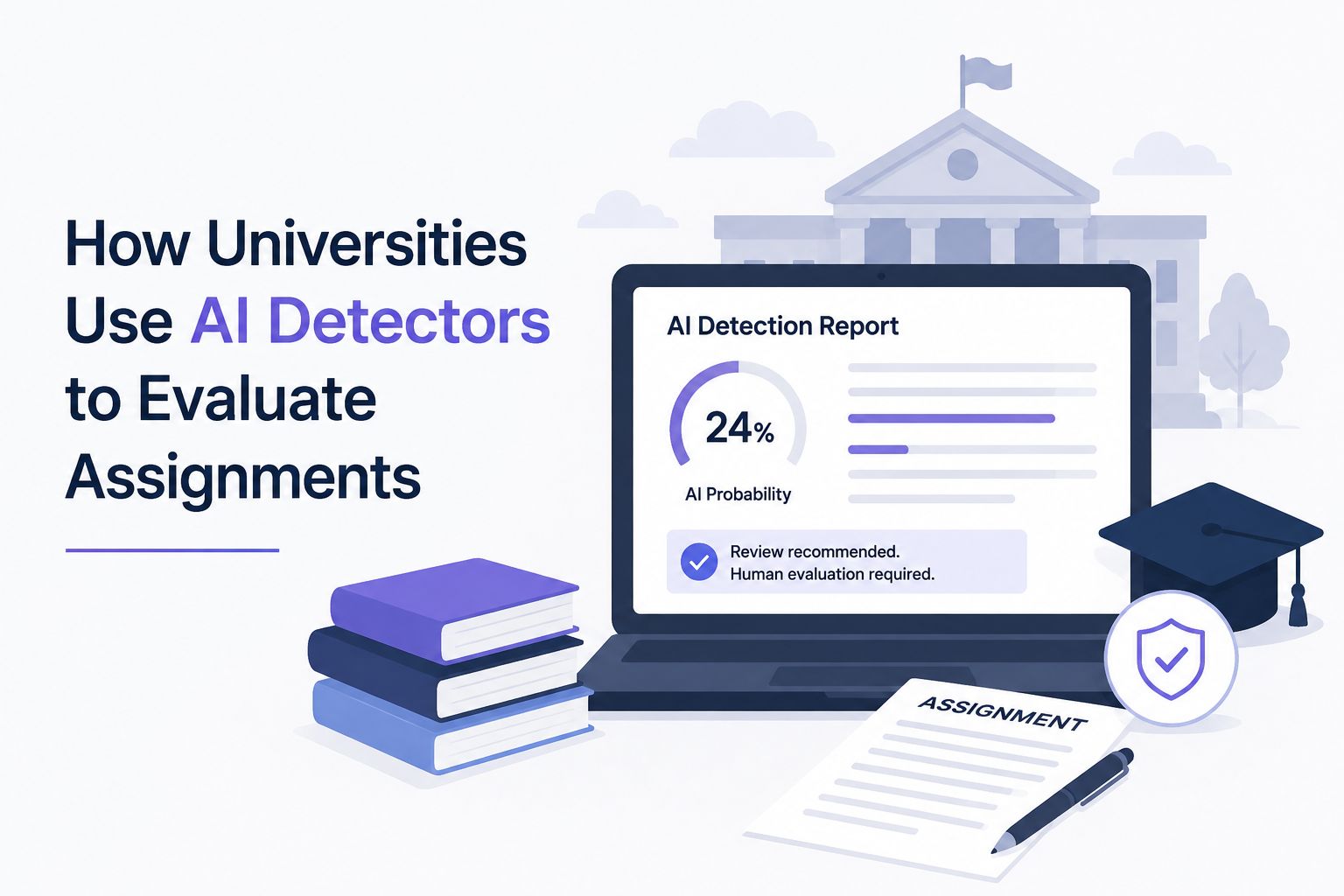
Not long ago, most students worried about plagiarism, citation mistakes, or missing references before submitting an assignment. Today, another question has become just as common: Will this paper be identified as AI-generated? That shift has led many students to review their work with an AI Detector before submission, while using a Grammar Checker to improve clarity, fix language errors, and strengthen the overall quality of their writing.
As artificial intelligence becomes part of everyday academic life, universities are adapting their policies. Some institutions allow AI for brainstorming or research support. Others restrict its use in specific assessments. Regardless of the policy, one thing is becoming increasingly common: AI detectors are being used as part of the review process.
What many students don't realize, however, is that these tools rarely make the final decision on their own.
Why Universities Are Using AI Detectors
Generative AI has made it easier than ever to produce essays, reports, summaries, and research drafts within minutes. While these tools can help students organize ideas or improve productivity, they have also raised concerns about academic integrity.
Universities have a responsibility to ensure that submitted work reflects a student's own learning. AI detectors provide one way to identify assignments that may require closer review, particularly when there are concerns about excessive AI assistance.
Their purpose is not to replace instructors but to support them during the evaluation process.
AI Detection Is Usually the Starting Point
One of the biggest misconceptions is that universities automatically accept whatever an AI detector reports.
In reality, many institutions treat AI detection results as an indicator rather than proof.
If an assignment receives a higher AI probability score, it may simply encourage an instructor to examine the work more carefully. They might compare it with the student's previous submissions, review writing style, evaluate supporting evidence, or ask follow-up questions about the assignment.
The detector highlights potential concerns. The academic review determines the outcome.
What Instructors May Consider
Universities often evaluate assignments using multiple factors rather than relying on a single software report.
These may include:
- Whether the writing style differs significantly from previous work.
- The quality and relevance of references.
- The accuracy of facts and citations.
- Whether arguments demonstrate original thinking.
- The student's ability to explain or defend their work if questioned.
This broader evaluation helps reduce the risk of making decisions based solely on automated analysis.
Different Universities Have Different AI Policies
There is no universal approach to AI in higher education.
Some universities allow students to use AI for brainstorming, outlining ideas, or improving grammar, provided its use is disclosed when required.
Others prohibit AI-generated content in certain assessments, particularly when assignments are designed to measure independent reasoning or writing ability.
Many institutions are still updating their academic integrity policies as AI technology continues to evolve. Students should always review their university's current guidance before using AI during coursework.
Responsible AI Use Is Becoming an Academic Skill
Higher education is increasingly shifting away from asking whether students should use AI at all.
Instead, the conversation is becoming more focused on how students use it responsibly.
For example, AI can help generate research questions, summarize background information, or suggest ways to improve readability. However, students remain responsible for verifying facts, interpreting evidence, developing original arguments, and ensuring that final submissions meet academic standards.
Using AI responsibly requires judgment, not simply access to technology.
Common Mistakes Students Make
Many problems arise not because students use AI, but because they rely on it too heavily.
Some common mistakes include:
- Submitting AI-generated text without reviewing it.
- Including inaccurate or fabricated references.
- Accepting factual claims without verification.
- Depending on AI instead of developing original analysis.
- Ignoring institutional policies regarding AI use.
These issues can affect both academic performance and credibility, regardless of whether an AI detector identifies the content.
Preparing an Assignment Before Submission
A careful review process can improve both the quality and integrity of academic work.
Before submitting an assignment, consider asking yourself:
- Have I checked every important fact?
- Are my references accurate and complete?
- Does the argument reflect my own understanding?
- Have I revised the language for clarity?
- Would I be comfortable explaining every section of this paper to my instructor?
These questions often provide more value than focusing only on an AI detection score.
AI Detectors Are One Tool, Not the Entire Process
AI detection technology continues to improve, but it still has limitations.
No detector can determine with certainty how a document was created or how much independent work went into developing the final version. Writing style, subject matter, and document structure can all influence detection results.
For that reason, universities generally combine software with academic judgment rather than allowing technology to make decisions independently.
Final Thoughts
AI is changing education, and universities are adapting alongside it. AI detectors have become one part of the academic review process because they can help identify assignments that deserve closer examination. They do not, however, replace instructors, institutional policies, or thoughtful evaluation.
For students, the best strategy is not to focus on avoiding detection. Instead, focus on producing accurate, well-researched, and genuinely original work. Use AI as a learning aid where permitted, verify everything you submit, and treat writing as an opportunity to demonstrate your own understanding rather than simply generate words.