Introduction
In the demanding arena of OEM manufacturing, achieving zero-defect precision in metal bending remains a critical and costly frontier. Minute angular or dimensional deviations in a bracket, chassis, or enclosure are not just minor flaws; they are direct catalysts for expensive assembly line stoppages, part rejections, and cascading project delays. Many engineers face this frustration, relying on generic parameters and iterative adjustments that struggle to produce perfectly fitting components on the first try, every time.
The root cause of this inconsistency lies in the unpredictable physics of materials, primarily metal springback, and a reliance on static data rather than dynamic, closed-loop process control. This article moves beyond basic theory to examine three strategic engineering solutions. By systematically integrating digital simulation, real-time adaptive control, and collaborative design for manufacturability, these methods provide a robust framework to eliminate rework and achieve reliable, first-time-fit production.
Why Does Springback Make Consistent, High-Angle Accuracy So Difficult to Achieve?
Achieving consistent high-angle accuracy is fundamentally challenged by the material property known as springback, where a metal’s elastic recovery varies dynamically with material batch, temper, and grain direction. This directly undermines precision engineering and frustrates assembly fit. Modern design adheres to tight angularity and position tolerances defined by standards like ASME Y14.5, and uncontrolled springback is the primary obstacle to meeting these geometric callouts, often causing assembly failures. Traditional reactive methods, like using fixed overbend charts, cannot adapt to material variability. True consistency requires a paradigm shift from compensation-based guesswork to a control-based manufacturing system that measures and adapts in real-time.
1. The Physics of Unpredictable Elastic Recovery
Springback is the inherent tendency of metal to return partially to its original shape after forming, driven by internal residual stresses. The degree of recovery is not a constant; it is influenced by multiple factors including the material’s specific alloy, its temper or hardness condition, and the orientation of the metal’s grain structure relative to the bend line. This inherent variability makes it nearly impossible to achieve consistent results using a one-size-fits-all approach, demanding a more sophisticated, data-driven methodology for high-volume repeatability.
2. The Language of Precision: GD&T and Functional Fit
Adherence to standards like ASME Y14.5 is non-negotiable for functional parts. This standard defines a precise system for communicating design intent, moving beyond simple linear dimensions to specify allowable variations in form, orientation, and location. Springback directly violates these specifications, particularly for angularity and perpendicularity. Without actively compensating for and controlling springback, manufacturers cannot guarantee that bent parts will achieve the necessary functional fit and interchangeability required in an assembly, leading directly to quality escapes.
3. Beyond Static Tables: The Need for Dynamic Control
Relying on static data tables or fixed “k-factors” is akin to using a dated map for a constantly changing landscape. These methods provide a starting point but cannot account for the lot-to-lot variations present in even the most consistent materials. The only way to consistently hit tight tolerances is to transition from open-loop processes, which execute a pre-set program, to a closed-loop system that measures the actual result of each bend and makes an instantaneous correction. This real-time feedback is the cornerstone of achieving zero-defect precision parts.
What Are the 3 Engineering Strategies for Zero-Defect Bending?
Achieving zero-defect precision parts requires moving beyond isolated tactics to embrace a holistic, systematic approach. The following three engineering strategies form a layered methodology that addresses root causes at the design, production, and process levels. These methods collectively transform metal bending from a skill-dependent operation into a reliable, data-driven science, ensuring predictable outcomes and eliminating costly rework.
- Front-Loading Quality with Digital Twin Simulation: The first and most proactive strategy is leveraging multi-physics simulation software to create a digital twin of the bending process. This allows engineers can move from reactive correction to predictive optimization. By simulating stress distribution, material flow, and springback, potential issues like tearing, deformation, or inaccurate final angles are identified and resolved in the virtual realm. This enables the optimization of bend radii, sequencing, and even material selection before any physical tooling is committed, ensuring the design is not only functional but inherently manufacturable. This shift to virtual prototyping prevents expensive mistakes, accelerates development, and forms the bedrock of a predictable, reliable precision metal bending service.
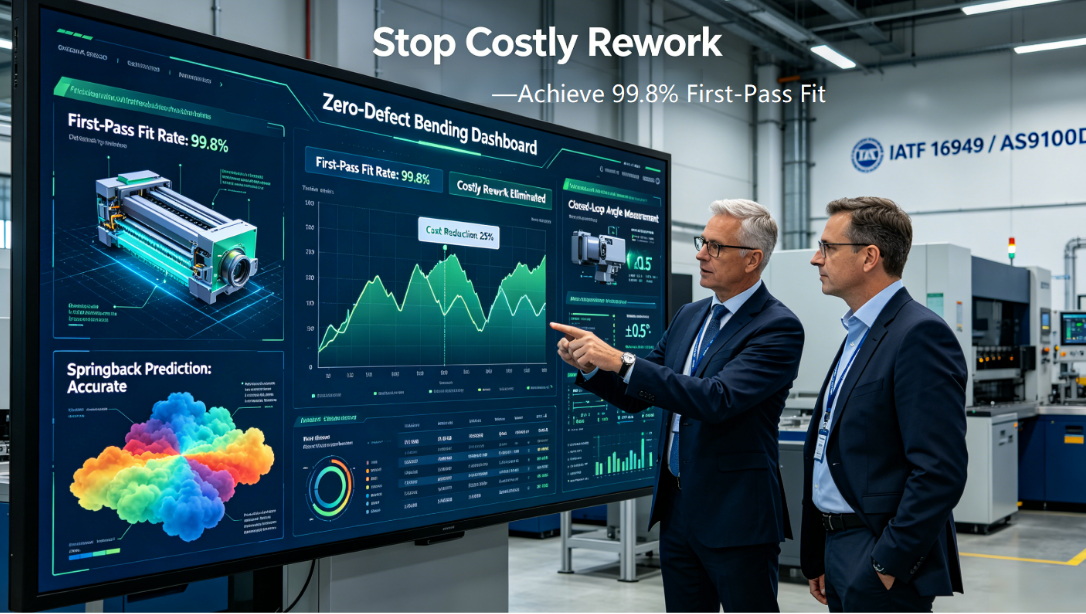
- Closing the Loop with Real-Time Adaptive Control: The second strategy, executed on the shop floor, implements real-time adaptive process control on modern CNC press brakes. These machines are equipped with advanced in-process sensors, such as laser scanners or contact probes, that continuously measure the actual bend angle as it forms. This live data is instantly fed back to the CNC, which compares it to the programmed target angle. Detecting any deviation — often caused by material property variations — the system dynamically calculates and executes a micro-adjustment to the ram’s position before the cycle completes. This closed-loop system effectively nullifies the effect of variables like springback for each individual bend, guaranteeing the high repeatability necessary for high-volume, high-precision production.
- Material-Specific Process Engineering and Recipe Development: The third strategy recognizes the necessity of tailoring the process to the material itself. A one-size-fits-all approach is insufficient for zero-defect outcomes. This stage involves deep collaboration between design and manufacturing to engineer the process around the specific alloy, temper, and grain direction. It dictates tooling selection, determining the need for polished or polymer-coated dies to protect sensitive finishes. It also defines the precise sequence of operations, such as performing cosmetic bends last. This holistic recipe development, which treats the material as a primary process input, is what distinguishes a true technical partner for complex precision forming from a basic fabrication shop.
How Can Advanced Process Control Eliminate Assembly Fit Issues?
Advanced process control directly tackles assembly fit problems by turning the manufacturing cell into a self-correcting system. It replaces post-process inspection with in-process validation, ensuring that every single part meets specification as it is made, thereby eliminating batch-level failures that disrupt production lines.
1. The Mechanism of Sensor-Driven Feedback and Compensation
Advanced process control is executed through a seamless “sense-adjust” cycle integrated into modern CNC press brakes. As the punch forms the bend, a high-resolution laser or touch probe sensor measures the actual flange angle in real-time. This live data is instantly fed back to the machine’s CNC controller, which compares it to the programmed target angle. If a deviation is detected — typically due to material property variations causing springback — the controller dynamically recalculates the required bottom-dead-center position and makes a micro-adjustment to the ram’s stroke, all within the same bending cycle. This real-time compensation nullifies the effect of variability, part by part.
2. Integrating Measurement into the Production Workflow
This technology transforms quality assurance from a separate, downstream activity into an integrated component of the production process itself. The system doesn’t just correct errors; it creates a continuous data stream of process performance. This data can be logged for full traceability, providing empirical evidence of process stability and part conformity. It ensures that the first part and the thousandth part are identical, which is the very definition of manufacturing precision required for automated, just-in-time assembly processes.
3. From Theory to Tangible Results in Assembly
The ultimate proof of this strategy is found on the assembly line. When every bracket, enclosure, or chassis component arrives with bends held to a consistent ±0.5° or better, assemblers experience a seamless fit-up. There is no need for manual forcing, shimming, or rework. This eliminates a major source of production bottlenecks and warranty claims. Implementing this level of control is the definitive feature of a capable OEM metal bending service, as a deep dive into the mechanics of this process explains. For a detailed technical exploration of how this closed-loop system functions, refer to this comprehensive guide on metal bending service.
Beyond Dimensions: How to Protect Critical Surface Finishes During Bending?
Achieving dimensional accuracy is only half the battle; preserving the integrity of critical surface finishes is equally vital for many applications. A part with perfect angles is useless if its anodized or brushed surface is marred by tooling marks. Protecting these finishes requires specialized tooling and meticulous process planning integrated from the outset.
- The Challenge of Cosmetic-Grade Forming: Standard steel tooling, while durable, can easily scratch, gall, or imprint on sensitive surfaces like anodized aluminum or brushed stainless steel. The high point loads and sliding contact during bending can permanently damage the finish, necessitating costly and inconsistent secondary polishing or leading to part rejection. This makes the bending process itself a threat to the final product’s aesthetic and functional surface properties, a challenge that standard custom metal bending for OEM must explicitly address.
- Engineered Tooling and Process Solutions: The solution lies in engineered tooling and a deliberate process sequence. This involves using specialized punch and die sets with polished, radiused working surfaces, and often employing softer tooling materials like polyurethane for the punch or die inserts. These tools distribute forming pressure more evenly, preventing concentrated stress points that cause marks. Furthermore, the bending sequence must be planned so that any cosmetic surfaces are formed in the final operation to avoid being scratched by subsequent handling or tooling.
- Validating Surface Integrity: Assuring surface integrity requires more than visual inspection. Suppliers adept at finish-critical metal bending will employ methods like digital microscopy at 50-200x magnification to compare surface topography before and after forming, providing objective evidence that the finish remains pristine. This attention to detail, aligning with industry surface treatment standards, is what separates a basic fabrication shop from a true precision metal bending service partner capable of delivering zero-defect precision parts in both dimension and finish.
H2: What Should Engineers Look for in a True Precision Sheet Metal Bending Partner?
Selecting a fabrication partner is a strategic decision that impacts product quality, cost, and timeline. Engineers must look beyond basic equipment lists and evaluate a supplier’s underlying engineering methodology and systemic approach to mitigating risk and ensuring consistency throughout the production lifecycle.
1. Evidence of a Closed-Loop, Data-Driven Process
The most critical indicator is a supplier’s move beyond anecdotal skill to a data-driven manufacturing process. Inquire specifically about their use of in-process angle measurement and real-time compensation. Do they describe their process in terms of sensor feedback, adaptive control, and statistical process control (SPC) data? A partner that can articulate how their machines measure and auto-correct for each bend demonstrates a foundational commitment to predictable outcomes rather than hopeful approximations.
2. Material and Application-Specific Expertise
A true partner possesses deep, documented experience with the specific materials and challenges relevant to your industry. This includes proven experience with high-strength alloys, aerospace-grade aluminum, or specialty materials that present unique forming challenges. They should be able to discuss the nuances of grain direction, temper, and springback compensation for these materials, not just generic mild steel. Furthermore, industry-specific quality certifications (e.g., IATF 16949 for automotive, AS9100D for aerospace) are not just plaques on the wall; they are evidence of a systematized quality management system that ensures traceability and continuous improvement.
3. Proactive Collaboration and DFM Partnership
The best partners engage as an extension of your engineering team. Look for a supplier that offers and insists on a collaborative Design for Manufacturability (DFM) review before quoting. They should proactively identify potential issues with bend radii, feature proximity, grain direction, and sequence, suggesting optimizations that enhance robustness and reduce cost. This proactive, engineering-centric approach is the hallmark of a true sheet metal bending supplier focused on your project’s total success, not just executing a print.
How Does Strategic Supplier Collaboration Optimize Total Cost of Ownership (TCO)?
A myopic focus on piece-part price is a common and costly error in procurement. True cost efficiency is measured by Total Cost of Ownership (TCO), which encompasses all expenses from design through production, assembly, and field failure. Strategic collaboration with a precision-focused supplier directly targets and reduces these often-hidden costs, delivering superior long-term value.
1. Quantifying the Hidden Costs of Defects and Delays
The most significant TCO drivers are often invisible on a quote: assembly line downtime for fitting mismatched parts, the labor and material waste of rework and scrap, premium freight charges for rush replacements, and the reputational damage of delayed product launches. A part that fails to fit can stall an entire production line, incurring costs orders of magnitude higher than the part’s price. A zero-defect precision metal bending service strategy, while sometimes carrying a marginally higher unit cost, is an investment in eliminating these catastrophic, variable expenses.
2. The TCO Optimization Model: First-Time-Right vs. Low-Bid
Consider a simplified model: Supplier A offers a part at 10.00witha510.50 with a near-zero defect rate and seamless assembly. While Supplier B’s piece price is 5% higher, the elimination of scrap, rework labor, and line stoppage costs results in a significantly lower total landed cost and a faster, more predictable time-to-market. The investment is in predictability and risk mitigation.
3. Strategic Sourcing as Risk Management
Ultimately, selecting a precision metal bending service partner is a form of supply chain risk management. You are purchasing not just a component, but certainty, reliability, and engineering partnership. This collaboration compresses development timelines through better DFM, ensures supply chain continuity with consistent quality, and protects your brand’s reputation by delivering products that perform as designed. This strategic perspective transforms the procurement function from a cost center to a value-driving partnership essential for OEM metal bending service success.
Conclusion
Achieving zero-defect precision in metal bending is a sophisticated engineering discipline that integrates materials science, digital simulation, and adaptive, closed-loop process control. It demands a move beyond traditional, experience-based methods to a data-driven methodology that preempts variation at the design stage and corrects it in real-time during production. For OEMs, embracing this approach is not merely a technical choice but a strategic business decision that optimizes total cost, accelerates time-to-market, and de-risks the entire production lifecycle. The path to flawless assembly begins with recognizing that precision is a system, not a hope.
FAQs
Q: What is the most common mistake in designing parts for metal bending?
A: The most frequent oversight is neglecting material springback compensation at the design stage, leading to angular inaccuracies. A robust practice involves consulting manufacturing experts early or utilizing simulation software to predict and design for springback, ensuring the as-designed geometry yields the correct as-formed part.
Q: How does real-time angle measurement work in advanced press brakes?
A: Advanced CNC press brakes use in-process laser or probe sensors to continuously measure the actual bend angle as it forms. This real-time data is fed back to the CNC controller, which instantly compares it to the target and executes a micro-adjustment to the ram’s position, compensating for springback dynamically within the same cycle.
Q: Can you achieve a pristine surface finish on anodized aluminum after bending?
A: Yes, but it requires specialized tooling and process planning. The solution involves using tools with polished, radiused edges and often softer materials like polyurethane. The process sequence is also critical, with cosmetic bends performed last to avoid tool marks from other operations.
Q: Why are certifications like IATF 16949 important for a metal bending supplier?
A: Certifications are evidence of a systematized, process-oriented quality management system. For a supplier, this means every step — from design review to inspection — is documented and improved. It provides assurance of consistency, traceability, and proactive risk management, crucial for mission-critical applications.
Q: What file format and information are most helpful when requesting a quote for a complex bent part?
A: Provide a complete 3D model (STEP/IGES) with defined bend lines and radii, and a detailed drawing specifying critical vs. reference tolerances. Also state the material specification (alloy, temper), grain direction relative to major bends, and all surface finish requirements. This enables an accurate DFM analysis.
Author Bio
The author is a precision manufacturing expert with over 15 years of experience in solving complex fabrication challenges. Their expertise lies in bridging the gap between design intent and production reality for demanding OEM applications. The author is associated with LS Manufacturing, an organization dedicated to providing advanced, engineered manufacturing solutions for global clients. For a detailed analysis of your design, you can obtain a free Design for Manufacturability (DFM) report to optimize your part and lay the foundation for zero-defect production on your next project.