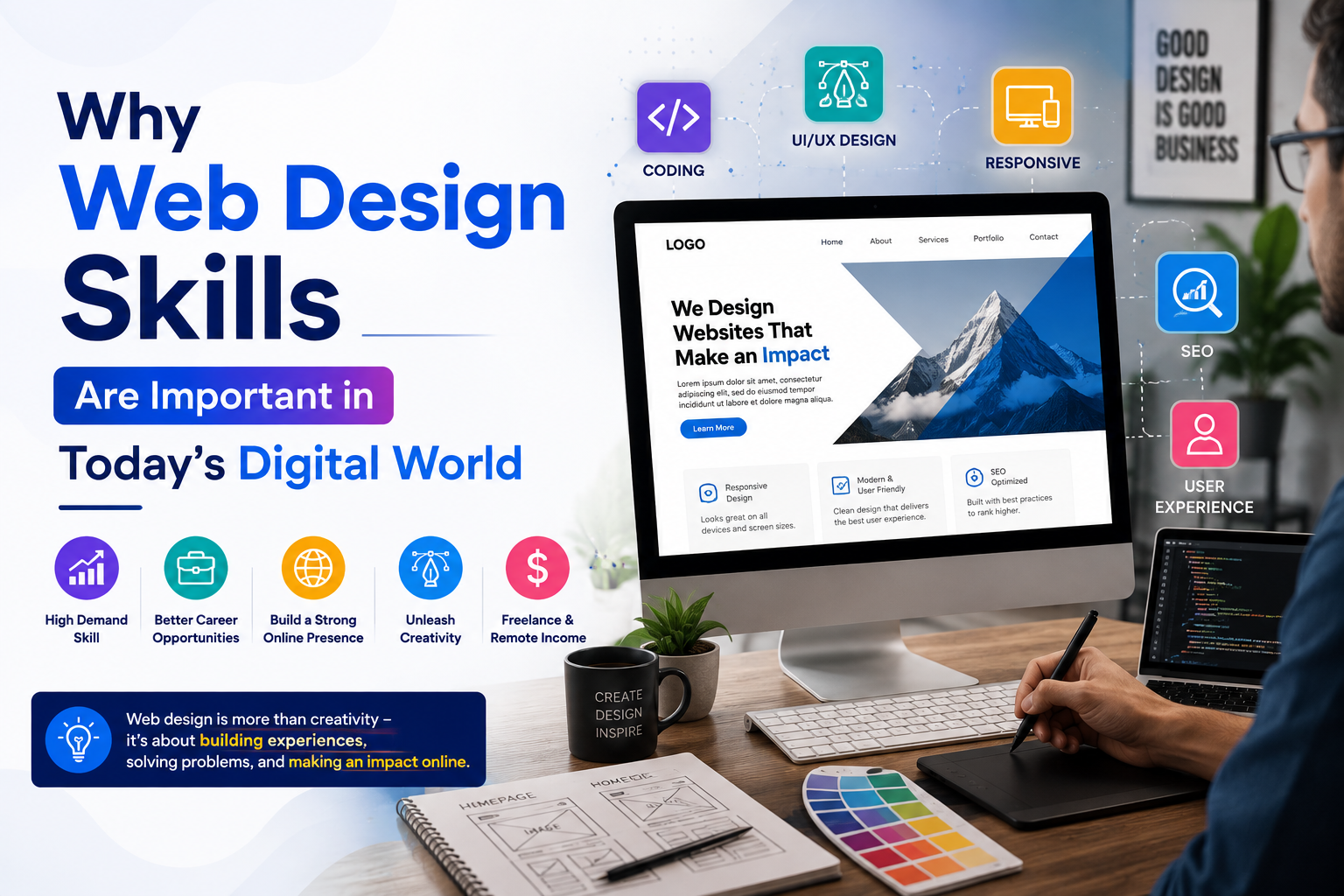
Short Answer: The relevance of web designing knowledge in 2026 lies in the fact that the website itself acts as the main shop front of the company, with design accounting for 94% of the initial impression made on a visitor, which happens in less than 50 milliseconds. In view of the more than 60% of traffic generated through mobile devices, Google’s mobile-first indexing method, and the influence of AI on website creation, competent web designers make all the difference.
The First Impression Happens Before Anyone Reads a Word
Much before your product, pricing, or marketing efforts influence the perception of a user, his perception of your website is already developed. As per studies, first impressions are design-driven and form within 0.05 seconds, that too way faster than the blink of an eye. Changing a perception is very difficult. Once your website is perceived as unprofessional and untrustworthy by a user, there will be nothing much that can convince him otherwise.
It is indeed a big problem. It is found that 38 percent of users leave a website if it is unprofessionally designed without ever getting to see its content. What’s more interesting is that 75 percent of customers believe in the credibility of a business on the basis of its website alone. Since the average person interacts with the screen multiple times every day, businesses have one chance to establish their credibility through design.
Why This Matters More in 2026 Than Ever Before
A number of trends have worked together to increase the demand for skills in web design to a higher level than has ever been seen in previous years:
- Webs sites are now universally used as the default first contact point for all companies. In today’s world, the vast majority of companies consider their websites to be their top marketing tool — the landing point where potential customers end up before making a call, visiting a store, or buying anything.
- Mobile web browsing is no longer the second experience; it is the first. Over 50% of all global web traffic is generated through mobile devices, and Google now crawls the mobile version of a website first. Designing without considering the mobile user is designing for a progressively shrinking user base.
- Speed and design have merged. Pages that are slow to load are more than an annoyance to visitors; they actively cut into a company’s bottom line. All retailers combined lose billions each year to slow-loading web pages, with even one second being measurable.
- AI has increased the standards rather than reducing them. The use of AI has made it easier for many designers to work on imagery, prototypes, and layouts. However, according to industry statistics, it has been proved that an experienced designer decides whether to convert an AI-generated prototype into a professional website or leave it as such.
- Inclusivity and accessibility have become basic requirements. With the increasing regulatory pressure and the expectation of users, accessibility is no longer an extra, but a basic need for businesses.
You can also explore all of RW Skill Education’s course offerings to find the right training path for your creative or tech career.
The Business Case: Design Is a Revenue Lever, Not a Cosmetic Choice
The financial impact of good versus bad web design is measurable and significant:
- Impact on conversion rate: UX design has been known to improve conversion rates to a level of up to 400%, and every dollar spent on UX design has been shown to generate returns up to $100.
- Building trust and credibility: About 90% of consumers are reported to be unlikely to return to a business after one negative experience with their website.
- Speed to revenue connection: A page that takes even one second to load will result in a reduction of conversion rates by about 7%, while those websites that take less than three seconds to load have engagement rates 50% higher than slower sites.
- Mobile-first benefit: Mobile-friendly websites perform better when compared to those where the mobile version was an afterthought.
Put simply: businesses that treat web design as a strategic investment consistently outperform those that treat it as a one-time setup cost.
The Skills That Actually Define a Web Designer in 2026
Now web design goes far beyond just “looking nice”. The field has evolved to become the crossroads between the art of visual communication, technical realization, and strategic thinking. The basic skills that are expected from an employer or a client include:
- Basics of UI/UX design – understanding how the use of layout, hierarchy, and flow can guide users’ behavior towards the desired result.
- Responsive and mobile-first design – going from small screens up and not vice versa.
- Skill with design tools – knowing how to use the main tool today, Figma, which became dominant in collaborative design and is now required in virtually all job listings for web or product design. In addition, having some basics in HTML5, CSS3, and JavaScript.
- AI-aided design – creating designs with the help of artificial intelligence-based tools for prototyping quickly, generating images, and performing accessibility testing, but remembering not to exclude the manual part from the process.
- Performance knowledge – studying how the size of an image, efficiency of code, and Core Web Vitals impact user experience and search engine optimization.
- Accessible design (WCAG) – designing for disabled users by default, not as an afterthought.
- Basic design skills like typography, color theory, and composition.
The designers who have these technical skills along with business skills – when they understand how each layout impacts conversions, not just visuals – are the most sought-after and best-paid designers.
Web Design as a Career Path
In addition to being a business tool, web design has emerged as one of the most effective and flexible ways to kick-start a career in technology. The global web design service market is valued at billions of dollars, and it continues to grow; its applications are required in every industry, including e-commerce, health care, education, real estate, and professional services.
The career paths available to someone with strong web design skills are broad:
- Web designer for the company/agency — designing business websites by oneself.
- UI/UX designer — one of the hottest specializations and the best paid, with the UI/UX field being worth billions and continuing to grow fast.
- Freelance web designer — a legitimate career option, as more employers admit the importance of practical experience in portfolio rather than degrees.
- Hybrid roles for front-end developers — designers who also know how to turn their ideas into reality with coding are especially valued by small teams and agencies.
- Designer focused on e-commerce and conversions — focusing on the design factors which have the biggest impact on sales.
How to Build These Skills the Right Way
Since web designing is both a craft and an application of technology, self-learning through tutorials is bound to have holes – especially in responsive design, accessibility, and Figma. The following elements would normally speed up this process in a more structured way:
- Projects that mimic real-life assignments, not just individual tasks.
- Learning of the most recent tools – Figma, prototyping, and AI-based design tools to meet the needs of the job market in 2026.
- Building a portfolio, since most job offers in the field of design depend not so much on certificates but rather on the work itself.
- Design criticism and mentorship, because you cannot replace criticism from professionals when studying alone.
- Business and client communication skills, since an increasing number of designers choose freelance work or agency work.
The Bottom Line
In an era where a website has only 50 milliseconds to establish its credibility, web design can no longer be considered a supporting profession, but rather a frontline business process. Organizations that put efforts into creating a good design experience measurable success in terms of conversion rates, customer retention, and credibility, while organizations that do not risk losing customers even before being able to present them anything. In case you are planning a career in a sphere of creativity or technology, web design can be considered one of the most useful skills to have.
If you’re ready to build this skill set with hands-on, industry-relevant training, our web design course in Surat covers responsive design, UI/UX fundamentals, and real client-style projects to prepare you for both agency and freelance work.
Frequently Asked Questions
Why should companies spend money on web design in 2026? This is because 94% of all impressions regarding website design are made within the first 50 milliseconds after visiting the site. In other words, website design will determine the credibility of the firm, hence affecting customer acquisition, retention, and conversion.
How does web design affect conversions? Web design can result in up to a 400% boost in conversion rates and up to 7% decline per second of page loading time.
Is it worth learning web design in the light of AI solutions? Yes, even though AI starts becoming more and more used for website design, according to industry statistics, human designers are still required for polishing up the results of AI and turning them into business-oriented material.
What skill should one master first in web designing? Responsive web designing, including mobile-first web designing and some UI/UX design basics, as more than half of the web traffic is mobile and Google starts its search from mobile versions of web pages.
Can one become a professional web designer without having a computer science degree? Yes, because currently most employers give preference to candidate’s portfolio and practical experience.