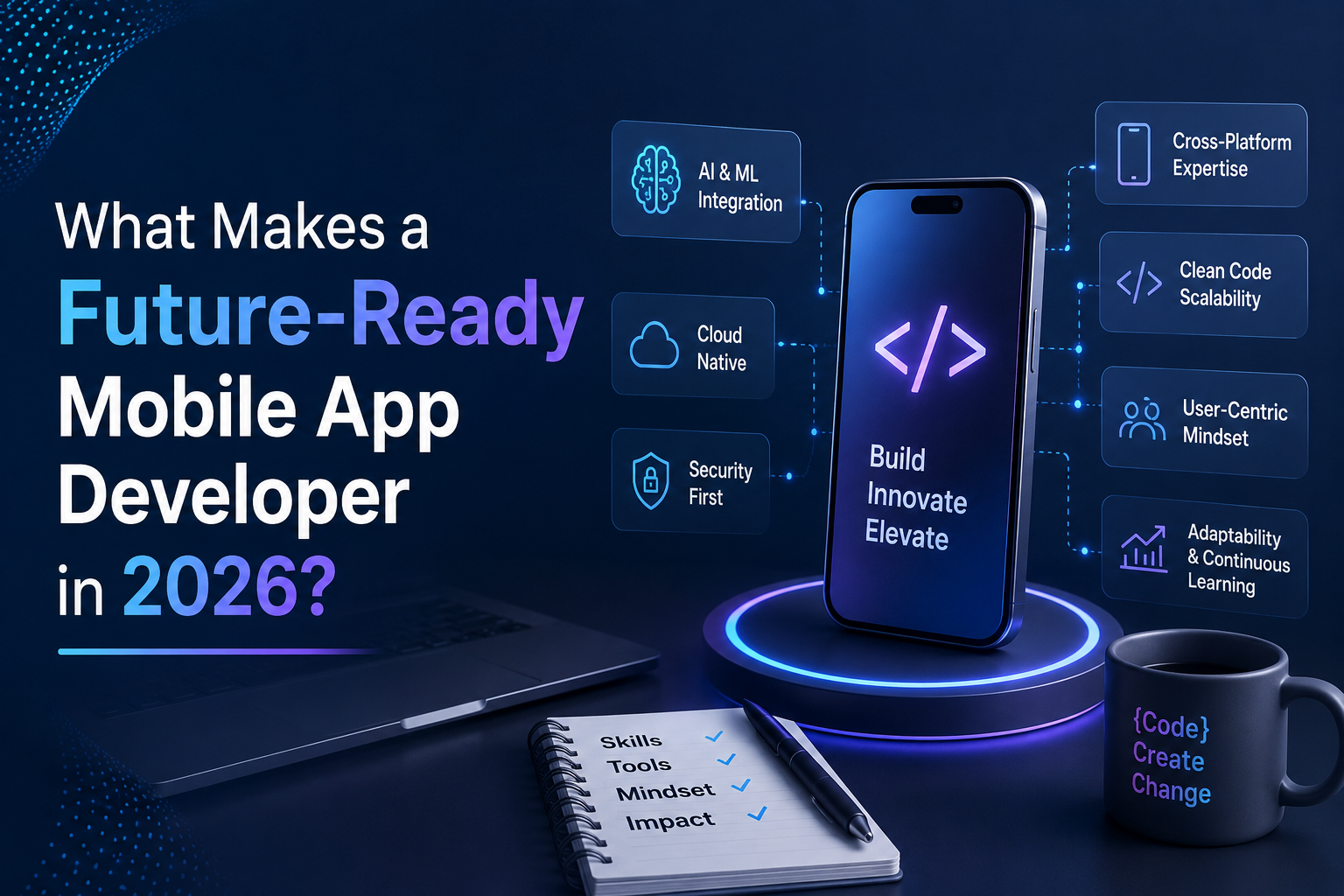
There is simply no way that mobile applications are anything but dynamic now. Customers demand from applications such features as contextual awareness, instant reaction, security, and consistency across different types of devices: phones, tablets, and smartwatches. At the same time, the development of artificial intelligence, cloud technology, automation, and cross-platform tools continues to transform the process of product development.
That shift is also changing what businesses should look for when they hire a developer. Clean code still matters that hasn’t gone anywhere but it’s no longer the whole picture. A good developer today also needs a handle on product requirements, emerging technologies, security, user experience, and knowing where AI genuinely belongs in a modern app.
If you’re a business planning an app in 2026, what you really want is a developer who can build for today’s needs without locking you into technical dead ends later.
Understanding the Mobile App Development Skills 2026 Demands
The mobile app developer skills that matter most right now go well past knowing a programming language. Developers need to understand how an app moves from an early design decision through to production monitoring. This makes it essential to hire mobile app developers who can handle full development cycles.
Some of the capabilities that stand out the most:
- Strong programming and software architecture knowledge
- API and backend integration
- Application security and data protection
- Performance optimization
- Automated testing and debugging
- Cloud and database familiarity
- AI and machine learning integration
- Cross-platform and native development experience
- Knowledge of accessibility and user experience principles
These are the skills that let a developer make sound technical calls on their own, rather than just executing instructions line by line.
1. Practical Knowledge of AI in Mobile App Development
Mobile app development trends 2026 have brought AI working its way into everyday app experiences recommendations, search, content generation, image analysis, conversational interfaces, personalization, automation, and more.
A future-ready developer doesn’t need to build a foundation model from scratch. What they do need is a real understanding of how to bring AI capabilities into an app responsibly.
In practice, that means being comfortable with APIs, model endpoints, vector databases, prompt workflows, on-device AI, and data privacy controls. It also means knowing when AI actually improves the experience and when a simpler, more conventional feature would just do the job better.
AI-driven mobile applications can provide customized suggestions or help in the form of natural language, no doubt. However, all of this does not work well unless proper data management, latency control, error handling, and user-controllable settings are in place.
2. Strong Command of Modern Development Technologies
Good programming principles still form the foundation of good software. However, mobile application development is a field that evolves rapidly. This is precisely why continuous learning can no longer be an option.
In Android development, Kotlin has emerged as the focal point for programming in the modern day. This is because the official documentation for Android suggests using Kotlin for Android projects alongside tools such as Jetpack Compose.
On Apple’s side, Swift is still the core technology. Apple’s current developer resources keep the focus on Swift, SwiftUI, SwiftData, testing, and modern concurrency features.
That’s exactly why Kotlin and Swift development remain such valuable skills for developers who want to stay close to what each platform can genuinely do.
3. Knowing When to Choose Native or Cross-Platform Development
The future-proof developer does not consider technological choices as a public opinion poll, because the right answer is not determined by the majority’s opinion. For each situation, it is always a matter of requirements imposed by the product.
Native app development seems to be more appropriate when the app takes full advantage of the API, hardware, performance, or unique user interface. This point is explicitly stated in the documentation of Kotlin Multiplatform itself.
Cross-platform app development, on the other hand, earns its keep when teams want to share code across platforms and cut down on duplicated work. Modern approaches can even blend shared business logic with platform-specific components wherever that makes the most sense.
A capable developer should be able to weigh both approaches against performance, budget, development speed, maintenance, and scalability, not just default to whatever happens to be trendy.
4. Security Can’t Be an Afterthought
Security isn’t something you tack on at the end of testing. Mobile apps regularly handle sensitive information account credentials, payment details, location data, personal records.
Developers need a real handle on secure authentication, authorization, encryption, secure API communication, token management, data storage, and the common mobile vulnerabilities that just keep resurfacing.
They also need to understand how security requirements shape architecture from day one. An app can be technically impressive and still turn into a serious liability for the business if the data inside it isn’t properly protected.
5. Performance and Scalability Thinking
An app that runs fine for 500 users can behave completely differently once thousands, or millions, of people start using it.
Future-ready developers think about performance from the start keeping an eye on network requests, memory usage, startup time, database queries, image handling, battery drain, and background processes as they build, not waiting until something breaks.
Scalability takes thoughtful architecture too. Developers need to understand how mobile clients talk to backend systems and how APIs, databases, caching, cloud infrastructure, and analytics all fit together.
6. Product and User Experience Awareness
Technical skill alone doesn’t guarantee a good app. Developers also need a genuine sense of how people actually use software.
Apple’s current app development guidance puts real emphasis on discovering user needs, prototyping, validation, and iteration as core parts of the design process not extras tacked on afterward.
That’s why a strong developer works well alongside designers, marketers, product managers, and business stakeholders. They ask the right questions when requirements are vague, flag technical risks early, and suggest fixes that actually make sense for the product.
7. AI-Assisted Development Without Losing Engineering Judgment
AI coding assistants are just one aspect of the programming process. They help to automate tedious code, elucidate unknown code, produce test scenarios, and identify problems.
But getting real value out of them takes judgment.
A future-ready developer still reviews what the AI generates, spots security risks, questions assumptions, and understands the architecture behind whatever got built. Speed only helps if it doesn’t come at the cost of maintainability or reliability.
8. Continuous Learning and Adaptability
This might be the most important trait of all the willingness to keep learning. The mobile app development skills 2026 demands today could look pretty different just a few years out.
Developers who keep up with platform updates, new frameworks, AI capabilities, security practices, testing methods, and emerging development models simply adapt faster when requirements shift.
For businesses, that means it’s worth evaluating candidates on how well they learn, not just what they already know.
What Businesses Should Look for in 2026
When you’re evaluating developers or development teams, don’t stop at years of experience. Ask whether the candidate can:
- Clarify their tech stack
- Go for both cross-platform and native solutions
- Implement AI without making everything too complex
- Make apps that are safe and truly scalable
- Know contemporary Android and iOS platforms
- Systematically test and monitor applications
- Collaborate comfortably with non-technical stakeholders
- Adapt to new tools and practices as they show up
The goal isn’t finding someone who knows every technology under the sun. It’s finding someone who knows how and when to use the right one.
Building Apps That Are Ready for What Comes Next
The process of developing mobile applications continues to trend towards more intelligent, connected, and adaptive applications. Artificial Intelligence is bound to influence the way mobile applications function even more in the future, and the native and cross-platform technologies are constantly improving.
A future-ready mobile app developer combines technical depth with curiosity, product awareness, security thinking, and the ability to adapt. Whether a project calls for native development, cross-platform architecture, AI integration, or some mix of the three, the developers who stand out are the ones who can make sound calls as the technology keeps changing.
For businesses planning a new app, bringing the right technical expertise early can shape everything: architecture, development speed, long-term maintenance, all of it. In case you’re looking to hire mobile app developers with the specific skills your product needs, or want to explore mobile app development company for broader support, it’s worth starting that conversation early.