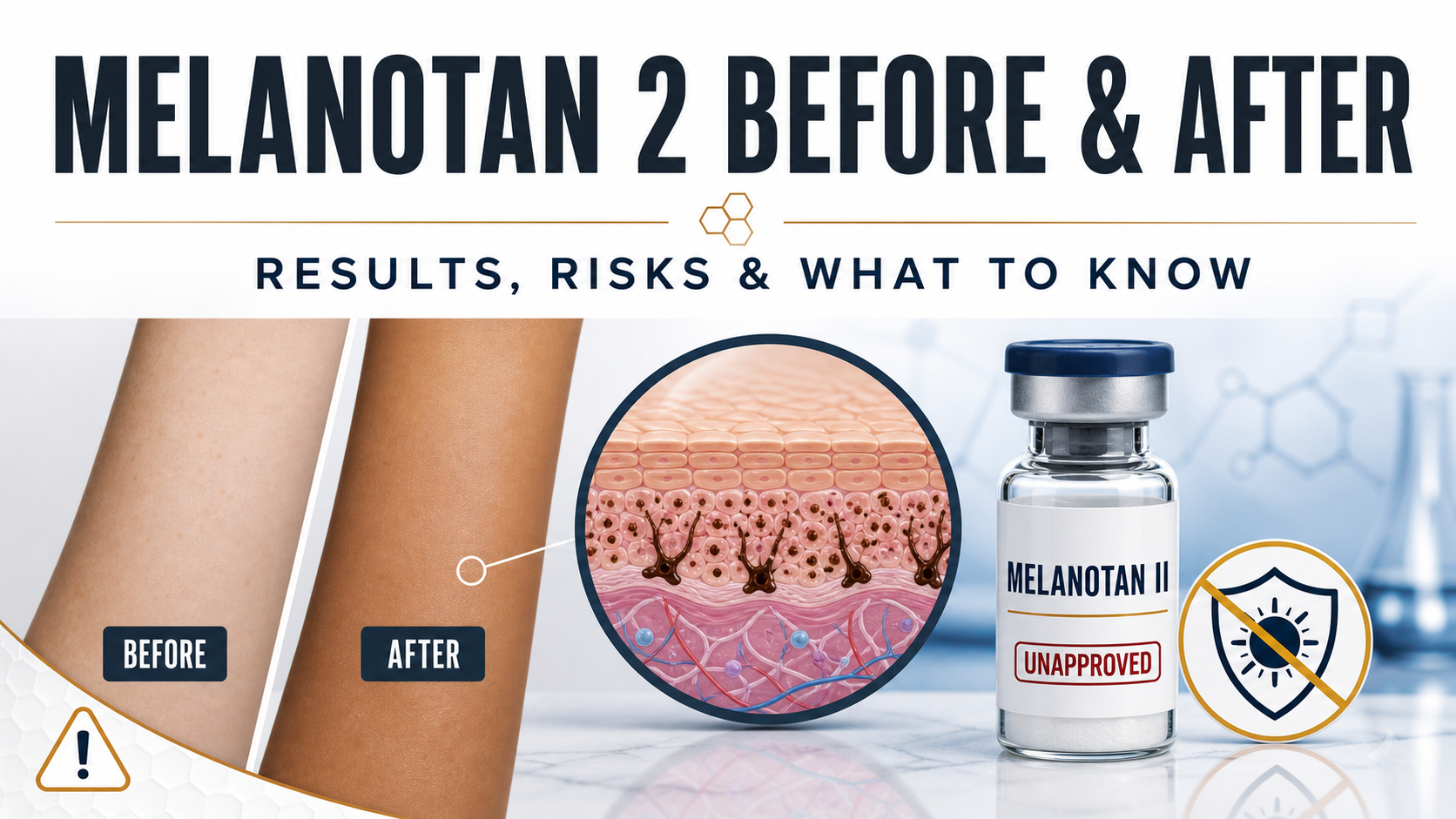
| Safety warning: Melanotan II is not FDA-approved for human use. Regulators warn that products sold online may not have been evaluated for identity, quality, safety, purity, or effectiveness. This article does not provide dosing or self-administration instructions. |
Quick Answer
Melanotan 2 before-and-after discussions usually focus on darker skin pigmentation, more noticeable freckles or moles, facial flushing, appetite changes, and other effects reported after exposure. A very small early clinical study found increased pigmentation in two of three male volunteers, measured one week after the experimental course ended. That finding shows biological activity, but it does not establish that Melanotan II is safe, approved, or appropriate for cosmetic tanning.
The most important fact is that Melanotan II remains an unapproved drug in the United States. Australia’s Therapeutic Goods Administration has also warned against tanning products containing melanotan because their quality and safety have not been assessed and serious adverse effects have been reported. A visible tan should never be interpreted as proof of safety or protection from ultraviolet radiation.
Visit the Peptide Stack library
Melanotan 2 Before and After at a Glance
| Question | Evidence-based answer | Important limitation |
| Can pigmentation increase? | A tiny early Phase I study observed increased pigmentation in two participants | The study included only three men and does not establish consumer safety |
| How quickly? | Pigmentation was measured one week after a short experimental course ended | There is no approved timeline or standardized consumer protocol |
| Does it prevent sunburn? | No reliable evidence establishes sun protection | A darker appearance is not a substitute for sunscreen or UV avoidance |
| Is it approved? | No. Melanotan II is not FDA-approved for human use | Online products may have uncertain identity, purity, potency, and sterility |
What Is Melanotan II?
Melanotan II, also written as Melanotan 2 or MT-II, is a synthetic cyclic peptide modelled on alpha-melanocyte-stimulating hormone. That natural hormone participates in pigmentation by activating melanocortin receptors and increasing the production of melanin. Melanin contributes to skin, hair, and eye color and helps the skin respond to ultraviolet exposure.
Melanotan II was investigated experimentally decades ago, but it did not become an approved tanning medicine. Products marketed online as injections, nasal sprays, or other preparations are not equivalent to an FDA-approved drug. A label saying “research use only” does not make a product approved, clinically validated, or safe for personal use.
What Did the Human Research Show?
The most frequently cited tanning evidence comes from a 1996 pilot Phase I study. It involved only three healthy male volunteers in a single-blind, placebo-controlled design. Two participants developed increased pigmentation of the face, upper body, and buttocks, documented by reflectance measurements and visual assessment one week after exposure ended.
The same study reported mild nausea at multiple experimental exposure levels. Stretching and yawning were associated with spontaneous erections lasting from one to five hours, and one participant experienced clinically significant sleepiness and fatigue. The study was designed as an early safety and activity experiment, not a large trial proving cosmetic effectiveness or long-term safety.
Later small studies investigated erectogenic effects rather than tanning. They also reported nausea, yawning, stretching, reduced appetite, and erections more often with Melanotan II than with placebo. None of this creates an approved indication, and the small sample sizes leave major uncertainty about uncommon or delayed harms.
A Realistic Before-and-After Timeline
Before exposure: skin, mole, and health baseline
A true baseline would include natural skin tone, existing freckles and moles, recent sun exposure, medications, and skin-cancer risk factors. Online photographs rarely provide this information. Lighting, white balance, filters, makeup, self-tanner, and intentional UV exposure can all create a stronger “after” image without proving what caused it.
The first hours and days
Reported acute effects include facial flushing, nausea, headache, vomiting, reduced appetite, yawning, stretching, fatigue, and spontaneous erections. These immediate effects are not evidence that tanning is progressing safely. Severe or prolonged symptoms require medical assessment rather than another exposure.
The first one to two weeks
The small pilot study observed pigmentation after a brief experimental period, but there is no regulator-approved schedule for a predictable cosmetic result. Pigmentation may appear unevenly, and freckles or moles may become darker or more noticeable. Any new, rapidly changing, irregular, bleeding, or symptomatic pigmented lesion should be evaluated by a dermatologist.
Several weeks later
A darker appearance may persist for a period as pigmented skin cells move through the normal skin-renewal cycle, but reliable duration data are limited. Continued sun or tanning-bed exposure can deepen color while independently increasing ultraviolet damage. That makes internet before-and-after photos particularly difficult to interpret.
After discontinuation
Pigmentation is not necessarily permanent. Skin tone can gradually move toward baseline as cells turn over and environmental exposure changes. However, the behavior of individual moles or freckles cannot be predicted from a general tanning timeline, which is another reason skin changes should not be dismissed as a routine cosmetic effect.
What Changes Might Appear in Photos?
- Overall skin darkening, which may be more noticeable on frequently exposed areas.
- Darker freckles, moles, or other pigmented spots.
- Uneven color caused by baseline pigmentation, UV exposure, or photography conditions.
- Temporary facial redness or flushing that can alter apparent skin tone.
- Appetite or weight changes reported by some users, although Melanotan II is not an approved weight-loss treatment.
Before-and-after images cannot verify the identity or concentration of the product, establish sterility, separate Melanotan II from sun exposure, or rule out editing. A photograph is therefore weak evidence for both effectiveness and safety.
Why a Tan Does Not Mean Sun Protection
A darker skin tone does not make unprotected ultraviolet exposure safe. Melanotan II has not been established as a sunscreen and should not be used as a substitute for broad-spectrum sunscreen, protective clothing, shade, or avoiding tanning beds. The FDA requires sunless tanning products without sunscreen to state that they do not protect against sunburn and that repeated unprotected tanning may increase skin-aging and skin-cancer risks.
The same practical principle applies here: visible pigmentation does not prove adequate ultraviolet protection. Combining an unapproved product with deliberate sun or tanning-bed exposure can add separate layers of risk.
Known and Reported Risks
Commonly reported effects
Regulatory and clinical sources describe nausea, vomiting, headache, facial redness, reduced appetite, fatigue, yawning, stretching, and sexual effects. Because products obtained online may vary, the actual exposure may be different from what the label claims.
Pigmented lesions and skin monitoring
Case reports and regulatory warnings have described increased freckles and moles, including concerning pigmented or dysplastic lesions. A case report cannot prove that Melanotan II caused every lesion, but rapid pigment changes should not be ignored. People with a personal or family history of melanoma, numerous atypical moles, or high ultraviolet exposure already warrant especially careful skin surveillance.
Serious systemic reactions
Published case reports include systemic toxicity, sympathomimetic symptoms, rhabdomyolysis, kidney dysfunction, and other severe reactions after self-administration. Rare reports cannot provide a precise incidence rate, but they show that the risk is not limited to temporary nausea or flushing.
Product-quality uncertainty
Unapproved online products may present risks related to incorrect identity, contamination, impurities, aggregation, potency, handling, and sterility. FDA materials specifically note potential immunogenicity concerns for compounded Melanotan II because of aggregation or peptide-related impurities.
Melanotan II vs. Approved or Regulated Tanning Options
Topical products containing dihydroxyacetone, commonly called DHA, can temporarily color the outermost skin layer without stimulating internal melanin pathways. DHA is permitted by the FDA for external application when used as directed, although it should not be inhaled, swallowed, or applied to areas such as the eyes and lips.
A regulated cosmetic is not risk-free, and a spray tan still does not provide sunscreen protection. However, it has a fundamentally different regulatory status from an unapproved injectable or nasal peptide sold online. For people seeking cosmetic color, discussing external options and sun protection with a dermatologist is a safer starting point.
How to Evaluate Online Before-and-After Claims
- Check whether the post discloses UV exposure, tanning-bed use, self-tanner, makeup, lighting, and filters.
- Look for consistent camera settings, location, posture, and time of day.
- Be skeptical of claims that a product prevents skin cancer or replaces sunscreen.
- Do not treat testimonials as proof of purity, sterility, or regulatory approval.
- Pay attention to newly darkened or changing lesions rather than judging only the overall tan.
Frequently Asked Questions
How long does Melanotan 2 take to show results?
A tiny early study observed increased pigmentation in two participants one week after the experimental course ended. That is not enough to establish a reliable consumer timeline, and there is no approved dosing schedule.
Is Melanotan 2 FDA-approved?
No. The FDA has identified Melanotan II as an unapproved drug, and it has taken enforcement action involving products marketed for human use.
Does Melanotan 2 protect against sunburn?
It should not be treated as sunscreen or proof that ultraviolet exposure is safe. Use established sun-protection practices regardless of skin tone.
Can Melanotan 2 make moles darker?
Increased pigmentation of freckles or moles has been reported. New or changing pigmented lesions should be assessed by a qualified dermatologist.
Are nasal sprays safer than injections?
A different route does not make an unapproved product proven safe. Regulators warn about melanotan products sold as nasal sprays as well as injectable and ingestible forms.
How long do the tanning effects last?
Reliable duration data are limited. Pigmentation may fade as skin cells turn over, but individual changes vary and UV exposure can affect the apparent result.
Final Takeaway
Melanotan 2 before-and-after photos may show darker skin, but they do not answer the most important questions: what was actually in the product, whether it was sterile, how much UV exposure occurred, and whether the skin changes were medically benign. Early human research demonstrated that Melanotan II can influence pigmentation, but the evidence base is small and the product remains unapproved.
Regulators warn about product-quality uncertainty and adverse effects ranging from nausea and flushing to changing pigmented lesions and serious systemic reactions. Anyone experiencing concerning symptoms or new skin changes should seek medical care. For cosmetic tanning, regulated external products and evidence-based sun protection are more appropriate topics to discuss with a dermatologist.
Selected Research and Regulatory Guidance
- U.S. Food and Drug Administration. Certain Bulk Drug Substances for Use in Compounding That May Present Significant Safety Risks.
- Therapeutic Goods Administration. Don’t risk using tanning products containing melanotan. 2025.
- Dorr RT, et al. Evaluation of melanotan-II in a pilot Phase I clinical study. Life Sciences. 1996.
- Nelson ME, et al. Melanotan II injection resulting in systemic toxicity and rhabdomyolysis. Clinical Toxicology. 2012.
- U.S. Food and Drug Administration. Sunless Tanners and Bronzers.