Most sellers never think about fulfillment hub selection. They ship inventory to Amazon and assume it goes where it needs to go. That assumption costs them thousands in unnecessary storage fees and delayed cash flow.
The truth is simpler than most realize: where your inventory lands in Amazon’s UK network directly impacts how fast it sells, how much you pay to store it, and whether you’ll hit Prime windows consistently. Get it wrong and you’re looking at 7-14 extra days of check-in time. Get it right and your margins improve immediately.
This isn’t about luck or Amazon’s preferences. It’s about understanding how Amazon routes inventory and structuring your shipments accordingly.
How Amazon Routes Your Inventory Across UK Facilities
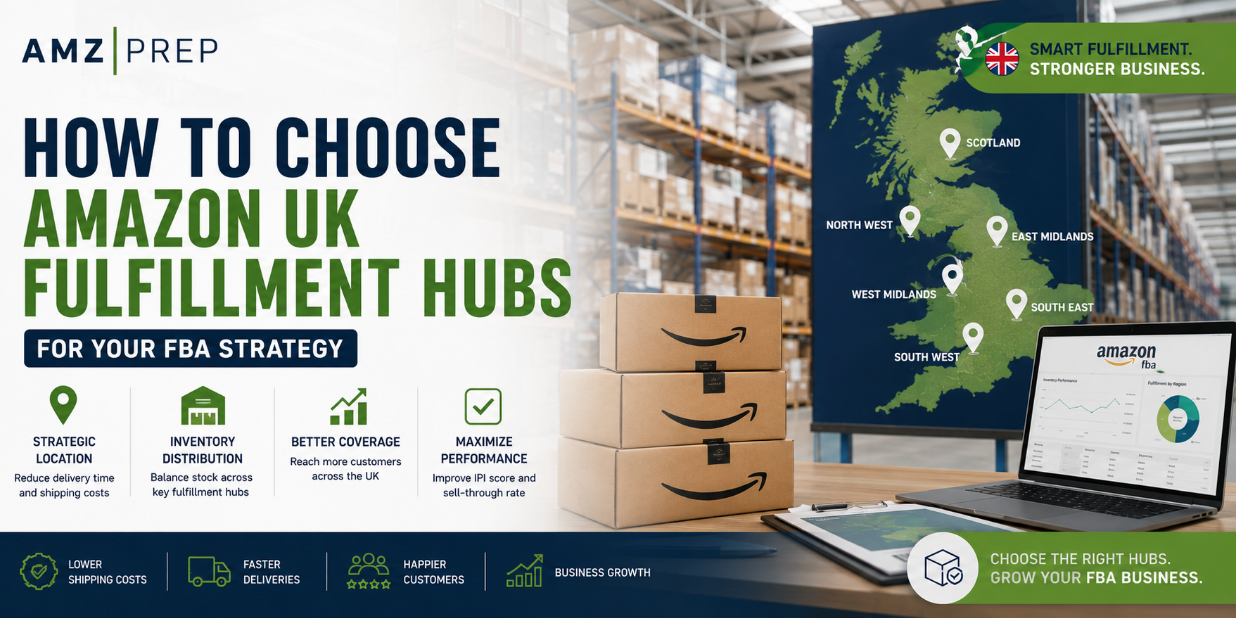
Amazon doesn’t operate one central warehouse in the UK. They run 20+ fulfillment centers spread across Scotland, Northern England, the Midlands, and the Southeast. When your inventory arrives, it doesn’t automatically go to the nearest facility or the one with the most capacity.
Understanding which Amazon fulfillment center UK locations receive your inventory starts with knowing how Amazon’s algorithm distributes stock. Instead, Amazon’s algorithm looks at three things: where your customers are buying from, which facilities have space, and how you’ve structured your shipment. That’s it.
The distributed model serves Amazon well. It gets products closer to London faster. Manchester gets stock faster. Glasgow doesn’t sit empty while the Southeast maxes out. But it also means you can’t just send inventory and hope for the best.
Here’s what most sellers miss: You can’t request a specific FC. Amazon won’t let you. But you can absolutely influence which facilities receive your stock through how you time shipments, split your orders, and structure your inbound plan.
Before you even structure your first shipment, use an Amazon FBA profit calculator to model different placement scenarios. Testing your strategy against margin projections ensures your inbound plan is actually profitable before you commit to it.
What Sellers Can Control (And What They Can’t)
Demand Geography Matters First
Your sales data tells Amazon where inventory should go. If 60% of your orders come from London and the Southeast, Amazon prioritizes FCs serving that region. If your sales are split between Manchester and Glasgow, your inventory gets split accordingly.
Before inbounding anything, pull 90 days of sales from Seller Central and break it down by region. Not just North vs. South. Get specific: How many orders from London? From Manchester? From Bristol? This data is the foundation of everything that follows.
If 70%+ of your sales come from one region, that’s your anchor point. Build your inbound strategy around that.
Timing Changes Everything
Inbound in April, May, or June and Amazon has capacity. FCs aren’t packed. Your inventory goes where demand suggests.
Inbound in July through September and you’re competing for shelf space with hundreds of other sellers doing back-to-school prep. Q4 is worse. Facilities hit capacity limits. When they do, Amazon doesn’t hold your inventory. It routes overflow to the next available location, which might be a remote facility in Scotland if you’re based in London.
This is why timing isn’t a footnote. It’s a strategic variable. A merchant sending 5,000 units in May will see very different routing than the same merchant sending identical stock in August.
How You Split Shipments Changes Placement
Send one 10,000-unit shipment and it lands in one FC. Manchester, probably. That facility now holds all your stock.
Send ten 1,000-unit shipments across ten weeks and something different happens. Amazon places smaller shipments across multiple FCs based on real-time demand. Your stock reaches London, Manchester, Glasgow, Birmingham. It’s distributed toward demand.
This matters because distributed inventory ships faster, sits in storage for shorter periods, and reaches customers quicker.
Why Hub Location Actually Costs You Money
Check-in delays are real
A facility in Scotland or Northern Ireland adds 7 to 14 extra days to your check-in window compared to a Southeast facility. You think inventory is in Amazon’s system. It’s not. It’s stuck in receiving, unprocessed, not for sale.
Those 14 days matter. Your IPI score takes a hit. Your sell-through slows. The item sits in a warehouse accumulating storage fees.
Storage fees compound
The per-cubic-foot fee is identical regardless of facility. But a remote facility means slower inventory turnover. Slower turnover means longer storage duration. Longer duration means more total cost, even at the same daily rate.
A product that takes 14 extra days to check in and 7 extra days to sell due to slower Prime eligibility sits an extra 21 days in storage. At $0.87 per cubic foot monthly (peak season), that adds up fast for a merchant with 5,000+ units in stock.
Placement fees are brutal if you miss the window
Amazon waives placement fees for inventory that arrives and sells within 45 days of FC arrival. Miss that window by a week because your shipment landed in a remote facility? You’re paying 5 to 10% of the sale price on every unit that goes past day 45.
For a $20 product with a 40% margin, a placement fee wipes out profit entirely.
Prime eligibility depends on location
Fast inventory in demand-dense regions ships same-day or next-day. Slow inventory in remote facilities doesn’t. Customers see “2-3 day delivery” instead of Prime-eligible. Some skip the purchase. Others buy from a competitor’s listing instead.
Conclusion
The process doesn’t have to be complicated. It does have to be deliberate.
Understand your demand geography first. Identify your top two regions by sales volume. Before your next inbound, make sure your shipment structure and timing reflect that reality.
Monitor outcomes after each inbound. Which FCs received your inventory? Were they in high-demand regions or remote locations? Fast or slow to check in? This feedback shapes your next decision.
Adjust quarterly based on what the data tells you. Seasonal demand shifts. Summer inbound timing might differ from Q4 inbound timing. Your approach should flex accordingly.
Over time, this framework becomes intuitive. You’ll know which timing windows work best for your products and customer base. You’ll understand your inventory placement patterns well enough to predict them. You’ll structure shipments to optimize for placement without overthinking it.
Frequently Asked Questions
Can you request a specific Amazon UK warehouse?
No. Amazon’s algorithm assigns facilities. You can’t bypass it. But you can influence outcomes through timing, shipment structure, and demand signaling.
How many UK warehouses does Amazon operate?
20+. The exact list changes as Amazon expands. Check Seller Central for current inbound addresses.
Does warehouse location actually impact conversion?
Yes. Faster inventory in high-demand regions reaches customers quicker. Prime eligibility improves. Out-of-stock risk drops. Conversion lifts measurably.
What if I’m split between multiple regions?
Use split shipments to reach multiple FCs. Send smaller quantities on staggered schedules rather than one bulk shipment. It’s harder to coordinate but placement improves significantly.
How much time difference between a southeast facility and a Scottish one?
Expect 7 to 14 extra days from Scotland. Sometimes 20+ days during peak season. Southeast facilities typically process in 3 to 5 days.
Does storage fee amount change by location?
No, per-cubic-foot fees are uniform. But remote facilities extend storage duration, increasing total costs.
Should I use an Amazon profit calculator for this?
Yes. Model different inbound timing and split strategies. See which scenario produces the best margin outcome. Use that data to inform your actual shipment plan.
How do I know if my current approach is working?
Check the Fulfillment Network report in Seller Central monthly. Track which FCs receive your inventory, check-in times, and storage duration. If inventory consistently lands in remote facilities and takes 20+ days to check in, your approach needs adjustment.