
Your phone buzzes with a number you don’t recognise. It could be a courier, a clinic or a scammer. Telcos report blocking more than 2.2 billion scam calls since December 2020, according to the ACMA, yet some still reach you. In 2024, phone scams caused the highest reported losses of any contact method, at $107.2 million, per the National Anti-Scam Centre. Every unknown caller forces a small decision: answer, ignore or check. This guide shows you how to verify an unknown caller, find out who called you and protect yourself when the answer looks wrong.
Why the Number on Your Screen Proves Nothing
Caller ID feels like proof. It isn’t. The ACMA explains that spoofing lets a scammer hide their real number and display a different, often Australian, one, which makes you more likely to answer. Scammers often pretend to be a bank, a government agency, a delivery company or a telco.
Your network helps, but only so far. Telstra Scam Protect flags some suspicious calls on eligible Telstra mobiles, and Telstra says it cannot guarantee every scam call will be flagged.
A displayed number alone never settles the question, so you need a second source. When a missed call from an unknown caller keeps nagging at you, a reverse phone lookup Australia search gives you one. Searqle matches the number against carrier records, public data and community reports. You get possible owner names, carrier, line type and a 0–10 risk score on one page, so you can decide whether to call back before you do.
How to Find Out Who Called Me From This Number in Australia
Australians search “who called me Australia” about 8,500 times a month, based on Ahrefs data. Most people try one quick check and stop. Work through these four in order instead.
- Let it go to voicemail. A genuine caller will leave a message for you to respond to.
- Read the prefix. The first digits show the line type.
- Search the number. A business listing or scam reports may appear in the results.
- Run it through a lookup, which brings carrier, line type and report history together.
Check Who Called You in Australia With a Lookup
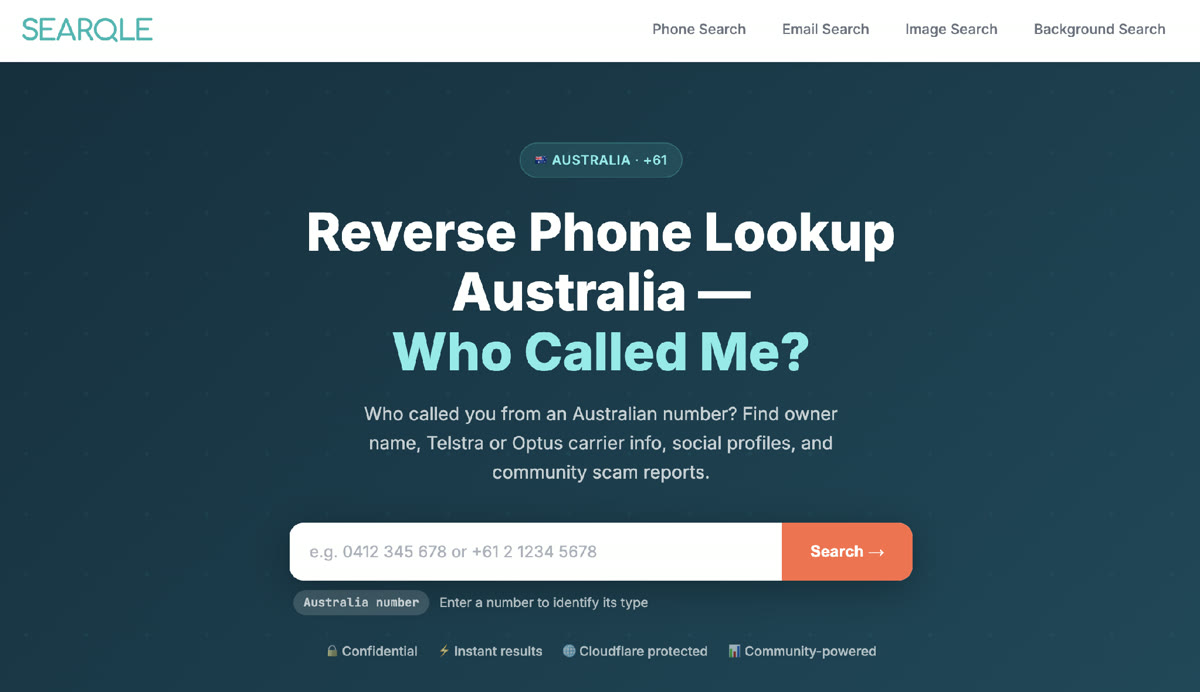
How it works: Searqle takes the number you paste in, with or without +61, and checks it against carrier records, public data and reports from people who received the same call. It then builds one results page. That page shows possible owner name matches, the carrier (Telstra, Optus or Vodafone), the line type (mobile, landline, VoIP or prepaid), linked online profiles and a risk score.
To start:
- Open the Australia lookup page and paste the number you missed.
- Wait for Searqle to check its sources. It handles the number formatting for you.
- Read the results: owner name, carrier, line type, profiles, community reports and risk score.
New users can start with a 7-day trial for €1.00. Plans then start at €13.90 a week (4 search credits) or €34.90 a month (20 search credits).
What a Reverse Phone Lookup Australia Report Shows and Where It Stops
A lookup answers a narrow question: what is known about this number? A report can show a possible owner name, a carrier, a line type, public profiles and the number of scam reports other people filed. Searqle says it draws on publicly available sources consistent with Australian privacy law and does not access private subscriber records held by carriers.
Treat a clean report with care. Spoofing means the number on your screen may belong to someone who never made the call. A lookup tells you about the number, not about the person on the line. Never return a missed call from an unknown number without checking it first, and contact your provider through its official channels.
How to Verify a Caller Who Claims to Be Your Bank, the ATO or Your Telco
The riskiest unknown caller is the one who sounds official. These steps work whatever number appears on your screen.
- Hang up. A caller who pressures you not to hang up or to verify the details another way is showing a red flag.
- Find the organisation’s number yourself, from its official website, its app or the back of your card. Never use a number the caller gave you.
- Call from a different phone where you can, so the scammer cannot stay on your line.
- Refuse to share passwords, PINs or one-time codes. Do not click links or install apps suggested during the call.
- Agree a secret word with family. University of Melbourne cybersecurity guidance suggests asking for it if either of you feels uncertain about a caller.
How to Protect Yourself and Report Scam Calls
- Turn on call screening. On iPhone, Silence Unknown Callers sends unknown numbers straight to voicemail. Android offers Caller ID and spam protection.
- Join the Do Not Call Register. It limits legitimate telemarketers, not criminals, so keep screening calls too.
- Report suspicious calls at Scamwatch. Reports help the National Anti-Scam Centre spot patterns.
- If you shared details or money, call your bank straight away. Then contact IDCARE, the national not-for-profit that supports people affected by identity theft.
Stay One Step Ahead of the Next Unknown Caller
An unknown caller counts on speed. You win by slowing the call down: let it ring out, read the prefix, check the number and call official numbers back yourself. When a missed call still bothers you, paste it into Searqle’s lookup to see carrier, line type, community reports and a 0–10 risk score before you respond. That gives you a clear reason to ignore, block or report the number. Whenever you wonder who called me Australia-wide, check first, and report anything suspicious to Scamwatch so the next person gets a warning.