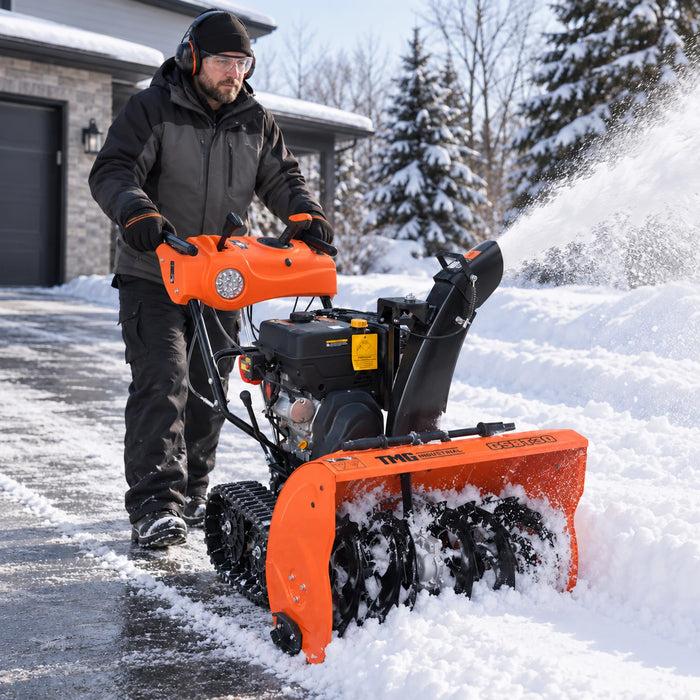
Everyone thinks about how fast a snow blower clears. Fewer people think about where the snow ends up. A30 inch track drive snow blower can throw snow 30 to 40 feet, which is a long way to throw something heavy, and a poor choice of direction puts snow on the road, against a window, or across a path that was just cleared. A few minutes of planning before the first pass with a track drive snow blower saves hours of rework.
The Chute Decides the Pattern
The TMG-GSBT30 has a discharge chute that rotates 180 degrees, controlled by a single-hand joystick with an adjustable deflector. That lets the operator change direction without stopping or taking a hand off the controls. The two-stage system uses serrated steel augers to break up packed snow and a 12 inch impeller to throw it, with a throwing distance listed at 30 to 40 feet. Treat that range as the reach of the snow, and check the landing zone, not just the path.
Wind Is Part of the Plan
A headwind throws snow back at the operator, and a crosswind carries it sideways and spreads it unevenly. Look at which way the wind is blowing before the first pass and throw downwind where possible. If the wind shifts, adjust the chute and the order of passes. A two stage snow blower is powerful, but wind can undo a pass of careful throwing in seconds, particularly in fine, dry snow.
Windrows and Layouts
On a wide driveway, start in the middle and throw to both sides, so each pass shortens the next. On a long, narrow one, throw to the downwind side and keep the pile low and even. Leave room at the end for the snow to go, and think ahead to later storms, since piles grow. Do not throw toward the street or onto a neighbor's property, and keep snow away from gas meters, vents, fire hydrants, and the base of the house.
Clearing Width and Intake
The clearing width is 30 inches, and the intake height is 21 inches, with a 12 inch auger. Wider is not always better. A 30 inch path suits driveways and walkways, and keeps the machine manageable around cars and corners. Deep drifts may need a shallow first pass to lower the load and a second pass to finish the job. Forcing the machine into snow that is too deep for the intake slows it and strains the drive.
Traction and Control
A tracked snow blower runs on rubber tracks with differential steering, which gives a firm grip on slopes, gravel, and uneven ground, and allows smooth turns. The transmission has six forward speeds and two reverse, so you can match the pace to the snow. A 375cc, 13 HP engine supplies the power, with 110V electric start and a recoil backup. Take it slowly on ice and on hills, and let the tracks do the gripping instead of rushing.
Comfort and Visibility
Heated hand grips, a bright LED headlight, and dashboard-mounted controls make a long session easier, particularly on dark mornings when most clearing happens. One-hand interlock operation keeps the safety control within reach. Wear warm gloves anyway, and keep your face covered when the wind is cutting. Fuel up outdoors with the engine off and cool, and never clear a jam by hand while the engine is running.