Choosing a college major can feel like guessing. You might pick what your friends are taking, what your parents suggest, or whatever sounds like it pays well. Then, two semesters in, you realize you dread every lecture.
There is a better starting point than guessing: your interests. Decades of career research show that people who study and work in areas that match their interests tend to stay motivated, perform better and are less likely to switch paths. One of the most widely used ways to measure those interests is the Holland Code, also called the RIASEC model.
This guide explains what the six Holland types mean, which majors line up with each one, and how to use your own code to make a smarter choice.
What are Holland Codes?
Psychologist John Holland developed his theory of career choice in the 1950s and refined it over the following decades. His central idea is simple: most people resemble a combination of six interest types, and most work environments can be described with the same six types. When your type matches your environment, you are more likely to be satisfied and successful.
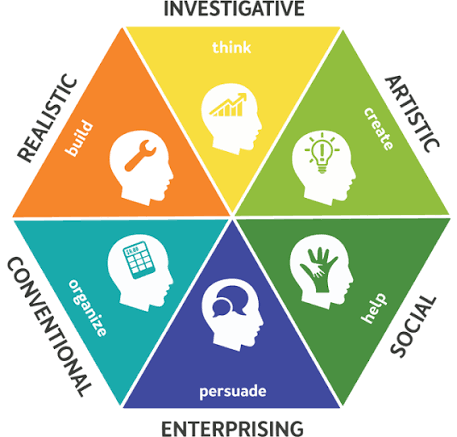
The six types are abbreviated RIASEC:
- Realistic (R) – “Doers” who like hands-on work with tools, machines, plants, animals or the outdoors.
- Investigative (I) – “Thinkers” who enjoy research, analysis, solving puzzles and figuring out how things work.
- Artistic (A) – “Creators” who value self-expression, originality and unstructured work.
- Social (S) – “Helpers” who like teaching, caring for, advising or working closely with people.
- Enterprising (E) – “Persuaders” who enjoy leading, selling, starting projects and taking risks.
- Conventional (C) – “Organizers” who prefer clear rules, data, detail and structured tasks.
Your Holland Code is usually written as your top three types in order, such as IRC or SEA. The first letter is your strongest interest, but the second and third letters matter a lot when you are comparing majors.
The U.S. Department of Labor uses this same model in its O*NET database, where every occupation is tagged with an interest profile. That makes Holland Codes a practical bridge between “what I enjoy” and “what jobs actually exist.”
Majors that fit each Holland type
No major belongs to only one type, but each one leans in a clear direction. Use this list as a starting map, not a final verdict.
Realistic (R)
Mechanical engineering, civil engineering, construction management, agriculture, forestry, environmental science, aviation and kinesiology. These majors involve building, fixing, measuring or working outdoors.
Investigative (I)
Biology, chemistry, physics, mathematics, computer science, economics, psychology and pre-medical tracks. If you love asking “why?” and digging through data or lab results, this is your zone.
Artistic (A)
Graphic design, fine arts, music, theatre, film, architecture, creative writing and English. These programs reward original thinking and give you room to experiment.
Social (S)
Nursing, education, social work, counseling, communication studies, public health and occupational therapy. Success here depends on empathy, patience and strong people skills.
Enterprising (E)
Business administration, marketing, management, finance, political science, hospitality and pre-law. These majors suit students who like influencing others, leading teams and making decisions.
Conventional (C)
Accounting, information systems, supply chain management, actuarial science, health information management and statistics. They suit students who enjoy accuracy, systems and well-defined procedures.
Why your second and third letters matter
Two students can share the same first letter and still need very different majors. Consider two Investigative students:
- An IRC student likes analysis but also enjoys hands-on, structured work. Engineering, data science or lab technology could be a great fit.
- An ISA student likes analysis but is also driven by people and creativity. Psychology, public health research or user-experience research might suit them better.
Holland also arranged the six types in a hexagon (R–I–A–S–E–C). Types that sit next to each other, like Investigative and Artistic, share more in common than types on opposite sides, like Artistic and Conventional. If your top letters are neighbors, your interests are “consistent,” and choosing a major is often easier. If they sit far apart, look for interdisciplinary programs that combine both sides, such as business analytics (E + C + I) or architecture (A + R).
How to find your own Holland Code
You can guess your code by reading the descriptions above, but self-assessment is surprisingly unreliable. Most of us overrate the interests we think we should have and underrate the ones we actually enjoy.
A structured interest assessment gives you a clearer picture. One free option built specifically for students is The College Major Quiz, which asks about your interests, your confidence in different subjects and what you want from a career. It then gives you a three-letter RIASEC interest code and matches you with bachelor’s degree majors, along with related careers, median pay and projected job growth based on U.S. Department of Labor data.
Whichever tool you use, look for one that:
- Asks about activities you enjoy, not just jobs you have heard of.
- Gives you a three-letter code rather than a single label.
- Explains why a major fits you, so you can judge the result yourself.
- Connects majors to real career outcomes, such as pay and job growth.
Turning your code into a decision
A Holland Code is a compass, not a GPS. Once you know yours, use these steps to move from “interesting idea” to a confident choice.
1. Shortlist three to five majors
Pick majors that match at least two of your three letters. This keeps your options focused without locking you into one path too early.
2. Check the coursework
Read the required course list for each major at your college. A Social student drawn to nursing should know it includes anatomy, microbiology and pharmacology. An Artistic student considering architecture should expect a lot of math and physics. Interest alone is not enough; you also need to be willing to work through the hard parts.
3. Look at the careers, not just the major
Search each major’s common jobs in O*NET or the Bureau of Labor Statistics Occupational Outlook Handbook. Look at daily tasks, typical salaries and job outlook. Sometimes a major that sounds perfect leads mostly to jobs you would not enjoy, and vice versa.
4. Test it in real life
Before you commit, try a sample of the work. Take an intro course, join a related student club, shadow a professional for a day or volunteer. Many students also find that preparing a seminar or presentation on a topic in a field they are considering is a low-risk way to see whether the subject holds their attention.
5. Talk to people who are already there
Ask juniors, seniors and recent graduates in the major what surprised them. Ask professionals what they wish they had studied. These conversations often reveal things no quiz or website can.
Common mistakes to avoid
- Choosing on salary alone. Pay matters, but a high-paying field that clashes with your interests often leads to burnout or a costly switch later.
- Ignoring your weaker letters. Your second and third types often explain why one major feels right and a similar one feels wrong.
- Treating results as permanent. Interests can shift, especially in your late teens and early twenties. Retake an assessment after your first year to see if anything has changed.
- Waiting too long. Changing majors late can add semesters and tuition. Exploring early, even in your first term, saves time and money.
Final thoughts
The right college major is not about finding a single perfect answer. It is about choosing a field where your natural interests, your strengths and the realities of the job market overlap. Holland Codes give you a research-backed way to find that overlap.
Start by learning your three-letter code, build a short list of majors that match it, and then test those options through classes, clubs and conversations. With a little structure, choosing a major stops being a guess and becomes a decision you can feel good about.