
The “golden sample” is the greatest enemy of the creative operations lead. We have all seen it: a developer launches a new model or interface with a breathtaking image—perhaps a hyper-realistic portrait or a complex architectural render—that suggests the era of manual asset creation is over. In a vacuum, the demo is flawless. But in a production pipeline, where a brand needs 500 variations of a product shot that must adhere to strict color hex codes and lighting angles, that single masterpiece is statistical noise.
For those building repeatable asset pipelines, evaluating generative tools based on their “peak capability” is a fundamental error. If you are responsible for scale, you don’t care about what a tool can do once in a hundred attempts; you care about its “mean performance.” You need to know what the output looks like when the prompt is average, the operator is tired, and the deadline is in twenty minutes. Comparing generative media tools requires moving past the feature checklist and into the territory of workflow friction and “Latent Resistance.”
The Fallacy of the Feature Matrix
In traditional SaaS procurement, a feature matrix is a reliable guide. If Tool A has “Inpainting” and Tool B does not, Tool A wins that round. In generative media, this logic collapses because AI features are not binary; they are gradients of probabilistic success. An “Object Eraser” in one tool might use a primitive content-aware fill that leaves visible smearing, while another might use a sophisticated latent-space reconstruction that seamlessly replaces pixels. Both claim the feature, but only one is production-ready.
The danger here is “Feature Parity Illusion.” A team might choose a platform because it checks every box—upscaling, background removal, face swapping—only to find that each of those features requires three additional manual cleanup steps in Photoshop to meet brand standards. When evaluating an AI Image Editor, the question is not “Does it have this feature?” but “What is the floor of its output quality?” Creative ops must prioritize the reliability of the “floor” over the height of the “ceiling.”
Furthermore, the quality of these features is often tethered to the underlying model weights and latent space bias. Some models are inherently better at textures, while others excel at lighting. If your pipeline requires consistent high-fidelity textiles, a tool optimized for cinematic lighting but poor on micro-detail will fail you, regardless of how many features it lists in its marketing materials.
Quantifying Latent Resistance and the Correction Tax
To move beyond vibes-based evaluation, teams should adopt two specific metrics: Latent Resistance and the Correction Tax.
Latent Resistance refers to the degree to which a generative model resists specific compositional or brand-mandated constraints. If you prompt for a “minimalist aesthetic” and the model consistently injects cluttered, maximalist backgrounds because its training data was biased toward high-contrast stock photography, that is high Latent Resistance. It is the friction between your intent and the model’s “opinion.” High resistance kills speed. You end up burning credits and time trying to “prompt engineer” your way around the model’s inherent tendencies.
The Correction Tax is the more tangible metric. It is the literal time, measured in minutes, that a human editor must spend fixing AI hallucinations or artifacts before an asset can be used. If an AI Photo Editor generates a near-perfect image but consistently fumbles the geometry of a product’s logo, the “tax” is the five minutes it takes a designer to mask and fix that logo. Across a 1,000-image campaign, that tax is 83 hours of high-value human labor
Evidence-first teams run “Blind Consistency Tests” to measure this. Have five different operators—not just your most “prompt-savvy” person—attempt the same complex edit using the same tool. If the variance in quality is high, the tool is not a pipeline solution; it’s a hobbyist’s toy. Predictability is the only currency that matters at scale.
Operational Velocity and the Frictionless Workflow
High-speed asset production is often hindered by “Tool-Switching Cost.” This is the friction of moving a project between specialized local environments or various browser tabs. In an ideal creative pipeline, the feedback loop between a raw generation and a finished, refined asset should be as tight as possible.
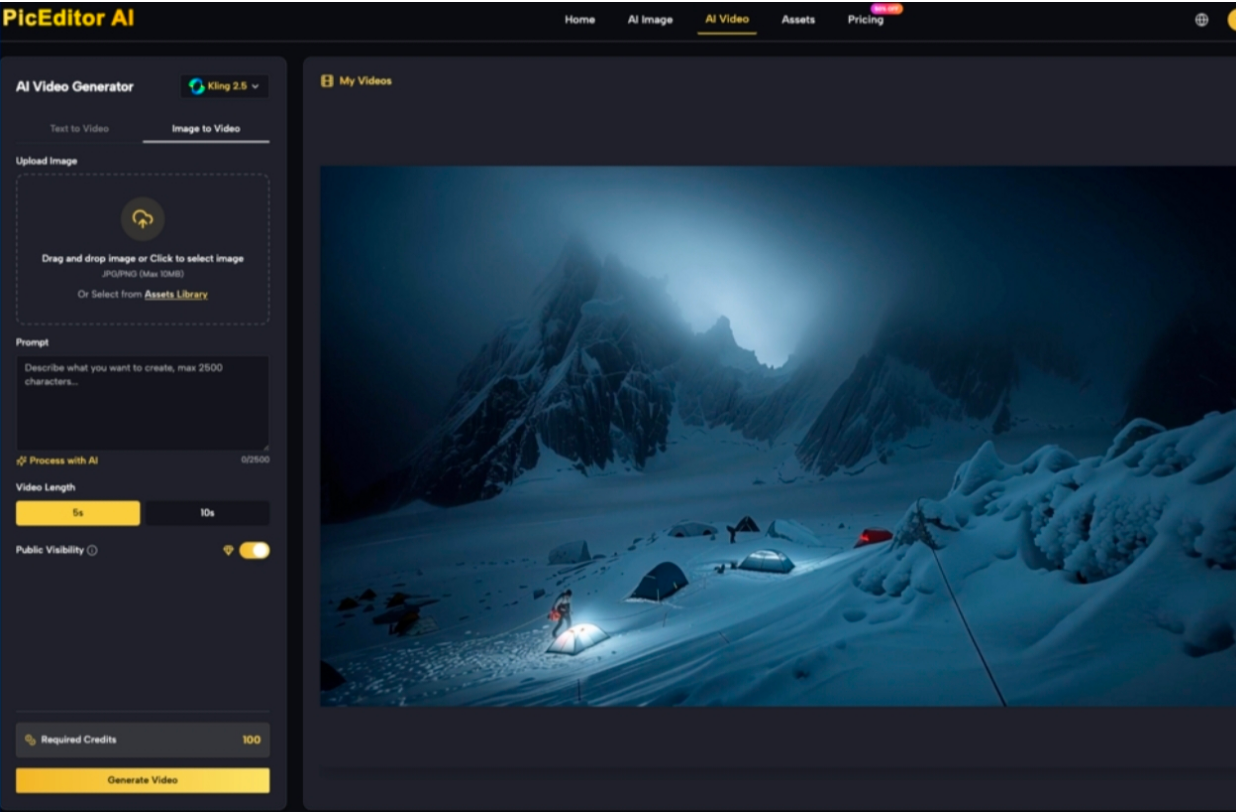
This is where the architecture of an AI Image Editor becomes critical. If an operator has to generate an image in one tool, download it, upload it to a separate upscaler, and then move it to a third tool for object removal, the pipeline is broken. A unified environment like PicEditor AI serves as a benchmark for how these workflows should be consolidated. By housing Face Swap, upscaling, and background manipulation within a single interface, the “switching tax” is effectively eliminated.
However, velocity is not just about having all the tools in one place; it’s about the UI logic. Does the interface anticipate that you will need to iterate? Or is it designed for a “one-and-done” user? In a professional setting, the first generation is almost never the final asset. The tool must allow for iterative refinement—adjusting a mask here, swapping a face there—without forcing the operator to restart the entire generation process from scratch.
The Infrastructure of Influence: Steerability over Power
There is a common misconception that more “powerful” models (those with higher parameter counts) are inherently better for production. In reality, “steerability” is far more valuable than raw power. A massive, unsteerable model is like a wild horse; it might be magnificent, but it won’t pull a plow.
For a creative lead, steerability means granular control. This includes brushes, precise masking, and parameter sliders that actually correspond to visual outcomes. “Vibe-based” prompting—relying on a string of adjectives to get the right look—is a liability in a repeatable pipeline. It is too subjective and too prone to variation.
An effective AI Photo Editor provides the operator with “levers” rather than just a “black box.” When evaluating a tool’s UI, look for how it handles the transition from text-to-image to image-to-image. Can you lock the composition while changing the style? Can you isolate a specific region for a re-roll without affecting the rest of the frame? These are the features that allow an operator to steer the model back to brand alignment when it inevitably drifts.
The Boundaries of Predictability
It is important to acknowledge the limitations of current generative technology to avoid over-committing to a flawed workflow. One of the most significant uncertainties is “Model Drift.” As foundational models are updated or fine-tuned by their developers, the “logic” of your established prompt libraries can break overnight. What produced a “muted, corporate blue” last Tuesday might produce a “vivid neon cyan” after a silent backend update. This is why teams must build pipelines that are relatively model-agnostic, focusing on the workflow and the manual intervention points rather than over-optimizing for a specific model’s quirks.
Another reset of expectations involves the “Self-Correction” myth. There is a tendency to believe that the AI will eventually “learn” your brand style through repetition within the tool. While fine-tuning is possible, most web-based tools are not training on your specific inputs in real-time. The burden of brand consistency still rests almost entirely on human oversight.
Finally, no current benchmarking system can safely predict legal compliance or copyright safety with 100% certainty. Even the most sophisticated AI Image Editor operates within a grey area of training data transparency. This necessitates a human-led legal vetting layer at the end of every pipeline. No matter how “production-ready” an output looks, it remains a mathematical approximation of its training set, and until the legal frameworks catch up, skepticism remains the safest operational stance
In the end, the tools that win in a production environment aren’t necessarily the ones that create the most stunning art. They are the ones that offer the lowest Correction Tax, the highest steerability, and the most predictable “floor” for high-volume output. When you stop looking at the demos and start looking at the friction, the right choice for your pipeline usually becomes clear. An AI Photo Editor is only as good as the time it saves you when things go wrong.